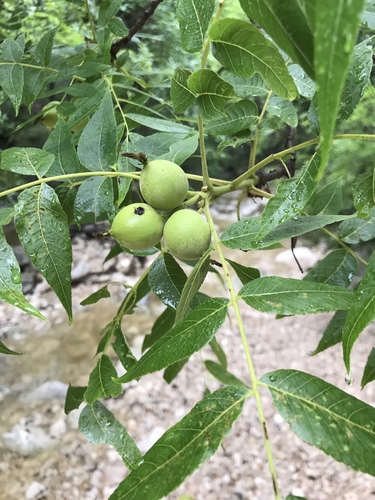
eastern black walnut
Juglans nigra
A large deciduous tree native to eastern North America, valued for its dark wood and edible nuts, though it produces allelopathic compounds that inhibit nearby plants. It develops a broad, spreading canopy and displays attractive golden fall foliage.
Overview
- Form
- Growth Rate
- Size
- Dormancy
Tolerances & Soil
Flood Tolerance
pH Range
Soil Texture
Seasonality
Bloom Season
Harvest Season
Season of Interest
Canopy
The tallest trees that form the overstory.
Succession Role
Native to the United States
Native Range
Eastern North America
Native to: Alabama, Arkansas, Connecticut, Delaware, Georgia, Illinois, Indiana, Iowa, Kentucky, Louisiana, Maryland, Massachusetts, Michigan, Minnesota, Mississippi, Missouri, New Hampshire, New Jersey, New York, North Carolina, Ohio, Pennsylvania, Rhode Island, South Carolina, Tennessee, Vermont, Virginia, West Virginia, Wisconsin
Function & Care
Edible Parts
Establishment & Care
- Establishment
- Maintenance
- Years to Bearing
- Propagation
Companion Planting
Plants well with
Avoid near
3
Notable Cultivars
Thomas and Carpathian are grafted cultivars selected for larger, thinner-shelled nuts and earlier nut production compared to seedling trees.