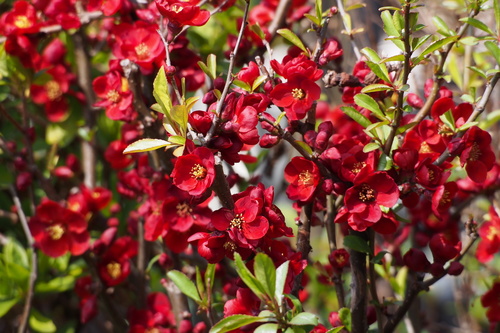
Flowering quince is a deciduous shrub prized for its early spring blossoms in shades of red, pink, or white, appearing before the leaves emerge. A hardy, low-maintenance ornamental with dense thorny growth, it is also valued by permaculturists for wildlife habitat and its small, fragrant fruit.
Overview
Form
Spreading
Growth Rate
moderate
Size
4–8′ tall × 4–8′ wide
Dormancy
deciduous
Tolerances & Soil
moderate
Zone 4aZone 9b
1471013
ColderWarmer
Zone range: Zone 4a to Zone 9b
Seasonality
Bloom Season
J
F
M
A
M
J
J
A
S
O
N
D
Harvest Season
J
F
M
A
M
J
J
A
S
O
N
D
Season of Interest
Spring
Shrub
Woody multi-stem plants at eye level.
Succession Role
pioneerearly successional
Native Range
China, Japan
Function & Care
ediblehedgerowpollinator nectarywildlife benefit
Edible Parts
fruit
Establishment & Care
Establishment
easy
Maintenance
low
Years to Bearing
2 years
Propagation
seed, cutting, layering, grafting
Companion Planting
Plants well with
Notable Cultivars
Texas Scarlet (bright red flowers), Cameo (double peach-pink blooms), and Toyo-Nishiki (mixed red and white flowers on the same plant) are among the most popular cultivars. These are ornamental selections distinct from edible quince (Cydonia oblonga).