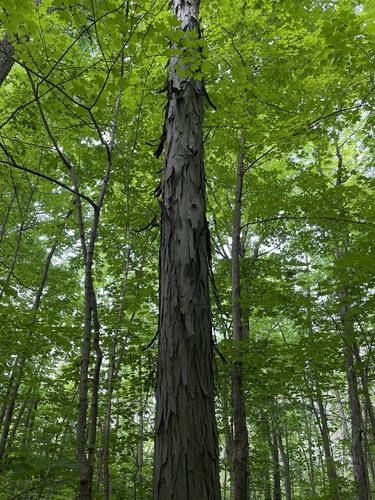
A large native deciduous tree valued for its distinctive shaggy gray bark, compound leaves that turn golden-bronze in fall, and edible nuts. It requires space to mature but provides excellent shade and wildlife food.
Overview
Form
Pyramidal
Growth Rate
slow
Size
60–75′ tall × 40–60′ wide
Dormancy
deciduous
Tolerances & Soil
moderate
Flood Tolerance
none
Zone 3aZone 9b
1471013
ColderWarmer
Zone range: Zone 3a to Zone 9b
pH Range
47.3
7.0
3.556.589
pH range: 4 to 7.3
Soil Texture
Coarse, Medium, Fine
Seasonality
Bloom Season
J
F
M
A
M
J
J
A
S
O
N
D
Harvest Season
J
F
M
A
M
J
J
A
S
O
N
D
Season of Interest
SpringFallWinter
Canopy
The tallest trees that form the overstory.
Succession Role
mid successionalclimax
Native to the United States
Native Range
Eastern North America
Native to: Alabama, Connecticut, Delaware, Georgia, Illinois, Indiana, Iowa, Kentucky, Massachusetts, Maryland, Maine, Michigan, Minnesota, Missouri, Mississippi, North Carolina, New Hampshire, New Jersey, New York, Ohio, Pennsylvania, Rhode Island, South Carolina, Tennessee, Virginia, Vermont, West Virginia, Wisconsin