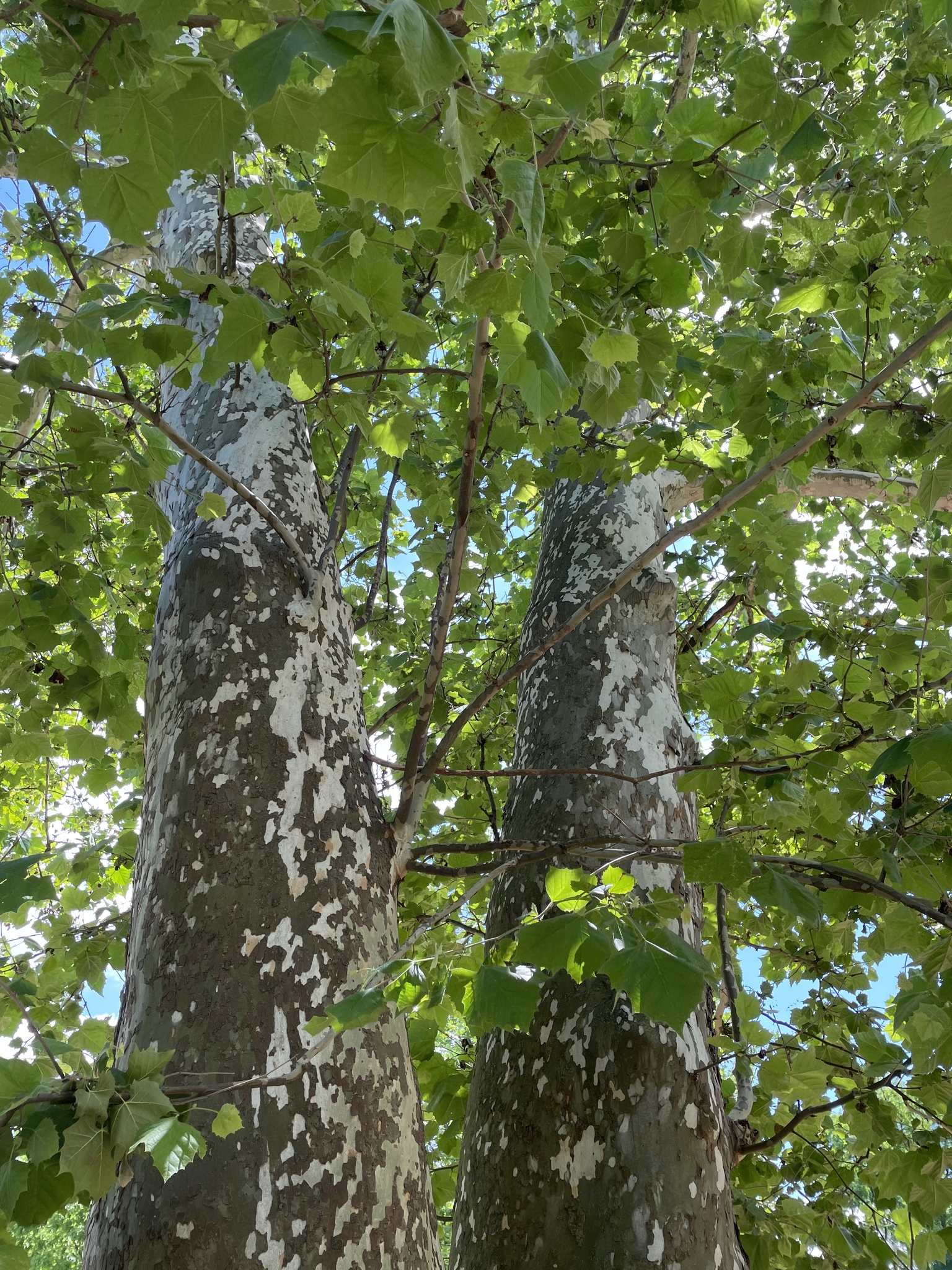
American Sycamore
Platanus occidentalis
Also listed as Platanus densicoma, Platanus excelsa
Also known as Sycamore, Eastern Sycamore, American Plane Tree
Climate Match for your location
See how well American Sycamore grows in your area.
Enter your ZIP code and we'll show you how this plant fits your local climate.
A large, fast-growing native deciduous tree with distinctive white and gray exfoliating bark and maple-like leaves that turn golden in fall. Excellent shade tree for large landscapes, particularly suited to riparian zones and wet areas.
Why grow it
American sycamore grows faster and larger than similar native shade trees like oaks, making it valuable where rapid canopy establishment matters. It tolerates wet, poorly drained soils better than most hardwoods and is particularly suited to stream banks and flood-prone sites where other species struggle. The exfoliating bark provides winter interest that persists year-round, unlike deciduous trees that rely on foliage alone.
Watch out for
This tree produces abundant seed balls and leaves that can require regular cleanup in maintained landscapes. Surface roots may develop in shallow soils or compacted sites, potentially affecting nearby structures or plantings. Branch angles can be weak in young trees, so early structural pruning helps prevent splitting as the canopy matures.
Overview
- Form
- Growth Rate
- Size
- Dormancy
- Family
- Platanaceae
Native to the United States
Native Range
Eastern North America
Native to: Alabama, Arkansas, Connecticut, District of Columbia, Delaware, Florida, Georgia, Iowa, Illinois, Indiana, Kansas, Kentucky, Louisiana, Massachusetts, Maryland, Maine, Michigan, Missouri, Mississippi, North Carolina, Nebraska, New Hampshire, New Jersey, New York, Ohio, Oklahoma, Pennsylvania, Rhode Island, South Carolina, Tennessee, Texas, Virginia, Vermont, Wisconsin, West Virginia
Seasonality
Season of Interest
Canopy
The tallest trees that form the overstory.
Succession Role
Tolerances & Soil
Flood Tolerance
Deer Resistance
Inferred from USDA browse palatability
pH Range
Soil Texture
Establishment & Care
- Establishment
- Maintenance
- Propagation
A large, fast-growing native deciduous tree with distinctive white and gray exfoliating bark and maple-like leaves that turn golden in fall. Excellent shade tree for large landscapes, particularly suited to riparian zones and wet areas.
Climate Match for your location
See how well American Sycamore grows in your area.
Enter your ZIP code and we'll show you how this plant fits your local climate.
Why grow it
American sycamore grows faster and larger than similar native shade trees like oaks, making it valuable where rapid canopy establishment matters. It tolerates wet, poorly drained soils better than most hardwoods and is particularly suited to stream banks and flood-prone sites where other species struggle. The exfoliating bark provides winter interest that persists year-round, unlike deciduous trees that rely on foliage alone.
Watch out for
This tree produces abundant seed balls and leaves that can require regular cleanup in maintained landscapes. Surface roots may develop in shallow soils or compacted sites, potentially affecting nearby structures or plantings. Branch angles can be weak in young trees, so early structural pruning helps prevent splitting as the canopy matures.
Overview
- Form
- Growth Rate
- Size
- Dormancy
- Family
- Platanaceae
Native to the United States
Native Range
Eastern North America
Native to: Alabama, Arkansas, Connecticut, District of Columbia, Delaware, Florida, Georgia, Iowa, Illinois, Indiana, Kansas, Kentucky, Louisiana, Massachusetts, Maryland, Maine, Michigan, Missouri, Mississippi, North Carolina, Nebraska, New Hampshire, New Jersey, New York, Ohio, Oklahoma, Pennsylvania, Rhode Island, South Carolina, Tennessee, Texas, Virginia, Vermont, Wisconsin, West Virginia
Seasonality
Season of Interest
Canopy
The tallest trees that form the overstory.
Succession Role
Tolerances & Soil
Flood Tolerance
Deer Resistance
Inferred from USDA browse palatability
pH Range
Soil Texture
Establishment & Care
- Establishment
- Maintenance
- Propagation
Similar canopy trees you might consider:
Enter your ZIP code to see top native species and strong climate fits for you.