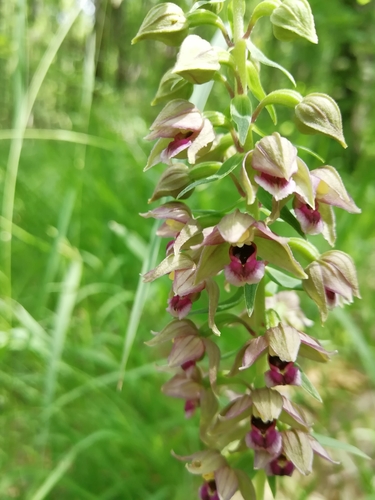
Broad-leaved Helleborine
Epipactis helleborine
Also listed as Serapias helleborine, Helleborine helleborine
Also known as Helleborine, Common Helleborine, Bastard Helleborine
Climate Match for your location
See how well Broad-leaved Helleborine grows in your area.
Enter your ZIP code and we'll show you how this plant fits your local climate.
A shade-loving orchid with distinctive greenish-purple flowers borne on tall spikes. This semi-saprophytic perennial thrives in woodland settings and is valued by native plant gardeners.
Why grow it
Broad-leaved helleborine offers woodland gardeners a shade-tolerant orchid option where many ornamental alternatives require brighter conditions. Unlike most temperate orchids, this semi-saprophytic species can establish in humus-rich soil without specialized mycorrhizal inoculants, making it more forgiving for native plant gardeners working to restore woodland understories. Its tall flower spikes and distinctive greenish-purple blooms provide visual interest during mid to late summer when many shade perennials have finished flowering.
Watch out for
Establishment from seed or small divisions can be slow, and plants may take several seasons to reach flowering size. This species prefers consistently moist but well-draining soil rich in leaf litter or compost; allow the planting area to dry out completely between waterings can stress plants. In drier climates or indoors, maintaining the humid microclimate it expects in woodland leaf litter may prove challenging.
Overview
- Form
- Growth Rate
- Size
- Dormancy
- Family
- Orchidaceae
Native Range
Europe, Western Asia, North Africa
Seasonality
Bloom Season
Season of Interest
Herb
Soft non-woody plants of the field layer.
Succession Role
Tolerances & Soil
Establishment & Care
- Establishment
- Maintenance
- Propagation
A shade-loving orchid with distinctive greenish-purple flowers borne on tall spikes. This semi-saprophytic perennial thrives in woodland settings and is valued by native plant gardeners.
Climate Match for your location
See how well Broad-leaved Helleborine grows in your area.
Enter your ZIP code and we'll show you how this plant fits your local climate.
Why grow it
Broad-leaved helleborine offers woodland gardeners a shade-tolerant orchid option where many ornamental alternatives require brighter conditions. Unlike most temperate orchids, this semi-saprophytic species can establish in humus-rich soil without specialized mycorrhizal inoculants, making it more forgiving for native plant gardeners working to restore woodland understories. Its tall flower spikes and distinctive greenish-purple blooms provide visual interest during mid to late summer when many shade perennials have finished flowering.
Watch out for
Establishment from seed or small divisions can be slow, and plants may take several seasons to reach flowering size. This species prefers consistently moist but well-draining soil rich in leaf litter or compost; allow the planting area to dry out completely between waterings can stress plants. In drier climates or indoors, maintaining the humid microclimate it expects in woodland leaf litter may prove challenging.
Overview
- Form
- Growth Rate
- Size
- Dormancy
- Family
- Orchidaceae
Native Range
Europe, Western Asia, North Africa
Seasonality
Bloom Season
Season of Interest
Herb
Soft non-woody plants of the field layer.
Succession Role
Tolerances & Soil
Establishment & Care
- Establishment
- Maintenance
- Propagation
Similar herbs you might consider:
Enter your ZIP code to see top native species and strong climate fits for you.