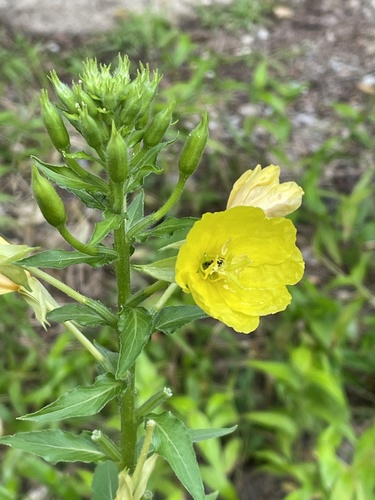
common evening-primrose
Oenothera biennis
Climate Match for your location
See how well common evening-primrose grows in your area.
Enter your ZIP code and we'll show you how this plant fits your local climate.
A biennial or short-lived perennial with bright yellow four-petaled flowers that open in the evening. Hardy and drought-tolerant once established, it self-seeds readily and attracts pollinators.
Overview
- Form
- Growth Rate
- Size
- Dormancy
- Family
Native to the United States
Native Range
Eastern North America
Native to: Maine, New Hampshire, Vermont, Massachusetts, Rhode Island, Connecticut, New York, New Jersey, Pennsylvania, Delaware, Maryland, Virginia, West Virginia, North Carolina, South Carolina, Ohio, Indiana, Illinois, Michigan, Wisconsin, Minnesota, Iowa, Missouri, Kentucky, Tennessee, Arkansas, Louisiana, Mississippi, Alabama, Georgia, Florida
Seasonality
Bloom Season
Harvest Season
Season of Interest
Herb
Soft non-woody plants of the field layer.
Succession Role
Tolerances & Soil
Flood Tolerance
pH Range
Soil Texture
Function & Care
Edible Parts
Establishment & Care
- Establishment
- Maintenance
- Years to Bearing
- Propagation
A biennial or short-lived perennial with bright yellow four-petaled flowers that open in the evening. Hardy and drought-tolerant once established, it self-seeds readily and attracts pollinators.
Climate Match for your location
See how well common evening-primrose grows in your area.
Enter your ZIP code and we'll show you how this plant fits your local climate.
Overview
- Form
- Growth Rate
- Size
- Dormancy
- Family
Native to the United States
Native Range
Eastern North America
Native to: Maine, New Hampshire, Vermont, Massachusetts, Rhode Island, Connecticut, New York, New Jersey, Pennsylvania, Delaware, Maryland, Virginia, West Virginia, North Carolina, South Carolina, Ohio, Indiana, Illinois, Michigan, Wisconsin, Minnesota, Iowa, Missouri, Kentucky, Tennessee, Arkansas, Louisiana, Mississippi, Alabama, Georgia, Florida
Seasonality
Bloom Season
Harvest Season
Season of Interest
Herb
Soft non-woody plants of the field layer.
Succession Role
Tolerances & Soil
Flood Tolerance
pH Range
Soil Texture
Function & Care
Edible Parts
Establishment & Care
- Establishment
- Maintenance
- Years to Bearing
- Propagation