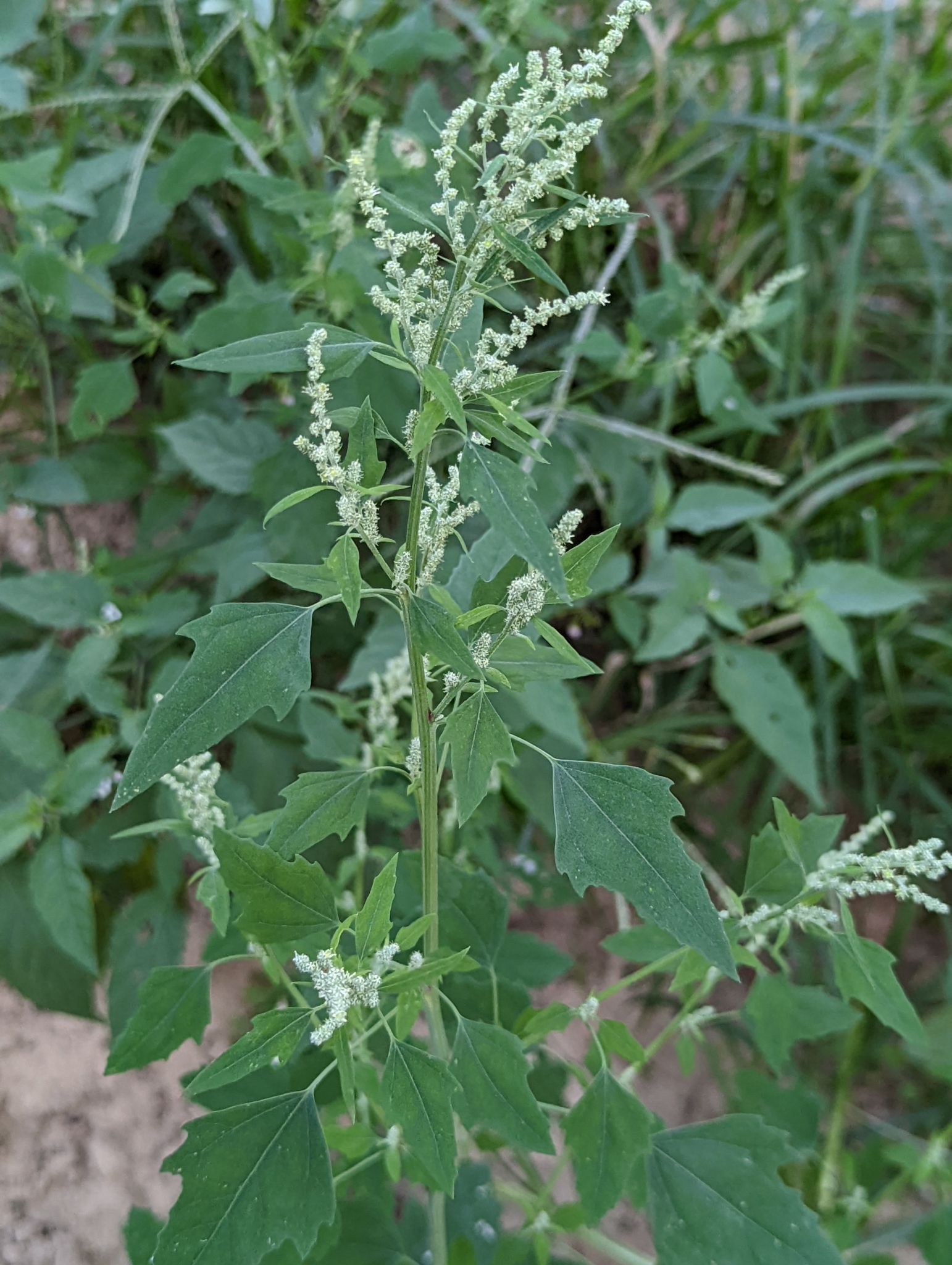
Common Lambsquarters
Chenopodium album
Also listed as Atriplex alba, Botrys albus
Also known as Lamb's Quarters, Fat-hen, White Goosefoot
Climate Match for your location
See how well Common Lambsquarters grows in your area.
Enter your ZIP code and we'll show you how this plant fits your local climate.
A fast-growing annual herb with mealy, pale green foliage and inconspicuous flowers followed by seeds. Commonly considered a weed but edible when young and nutritionally dense.
Why grow it
Lambsquarters establishes faster than most leafy greens and tolerates poor soil conditions where spinach or chard might struggle. Young leaves offer nutritional density comparable to cultivated greens with minimal input, making it useful for permaculturists seeking low-maintenance edible production. It also self-seeds readily, providing volunteer growth in subsequent seasons if some plants are left to mature.
Watch out for
This plant's prolific seed production means it can spread beyond intended planting areas if allowed to fully mature and drop seed. Repeated harvesting of young leaves will delay flowering, but some plants should reach maturity intentionally if you want self-seeding populations to establish in following years.
Overview
- Form
- Growth Rate
- Size
- Dormancy
- Family
- Amaranthaceae
Native to the United States
Native Range
Eurasia
Native to: Alabama, Arkansas, Connecticut, District of Columbia, Delaware, Florida, Georgia, Illinois, Indiana, Kentucky, Louisiana, Massachusetts, Maryland, Maine, Michigan, Mississippi, North Carolina, North Dakota, Nebraska, New Hampshire, New Jersey, New Mexico, New York, Ohio, Pennsylvania, Rhode Island, South Carolina, Tennessee, Virginia, Vermont
Seasonality
Bloom Season
Harvest Season
Edible Parts
Season of Interest
Herb
Soft non-woody plants of the field layer.
Succession Role
Tolerances & Soil
Establishment & Care
- Establishment
- Maintenance
- Years to Bearing
- Propagation
A fast-growing annual herb with mealy, pale green foliage and inconspicuous flowers followed by seeds. Commonly considered a weed but edible when young and nutritionally dense.
Climate Match for your location
See how well Common Lambsquarters grows in your area.
Enter your ZIP code and we'll show you how this plant fits your local climate.
Why grow it
Lambsquarters establishes faster than most leafy greens and tolerates poor soil conditions where spinach or chard might struggle. Young leaves offer nutritional density comparable to cultivated greens with minimal input, making it useful for permaculturists seeking low-maintenance edible production. It also self-seeds readily, providing volunteer growth in subsequent seasons if some plants are left to mature.
Watch out for
This plant's prolific seed production means it can spread beyond intended planting areas if allowed to fully mature and drop seed. Repeated harvesting of young leaves will delay flowering, but some plants should reach maturity intentionally if you want self-seeding populations to establish in following years.
Overview
- Form
- Growth Rate
- Size
- Dormancy
- Family
- Amaranthaceae
Native to the United States
Native Range
Eurasia
Native to: Alabama, Arkansas, Connecticut, District of Columbia, Delaware, Florida, Georgia, Illinois, Indiana, Kentucky, Louisiana, Massachusetts, Maryland, Maine, Michigan, Mississippi, North Carolina, North Dakota, Nebraska, New Hampshire, New Jersey, New Mexico, New York, Ohio, Pennsylvania, Rhode Island, South Carolina, Tennessee, Virginia, Vermont
Seasonality
Bloom Season
Harvest Season
Edible Parts
Season of Interest
Herb
Soft non-woody plants of the field layer.
Succession Role
Tolerances & Soil
Establishment & Care
- Establishment
- Maintenance
- Years to Bearing
- Propagation
Similar herbs you might consider:
Enter your ZIP code to see top native species and strong climate fits for you.