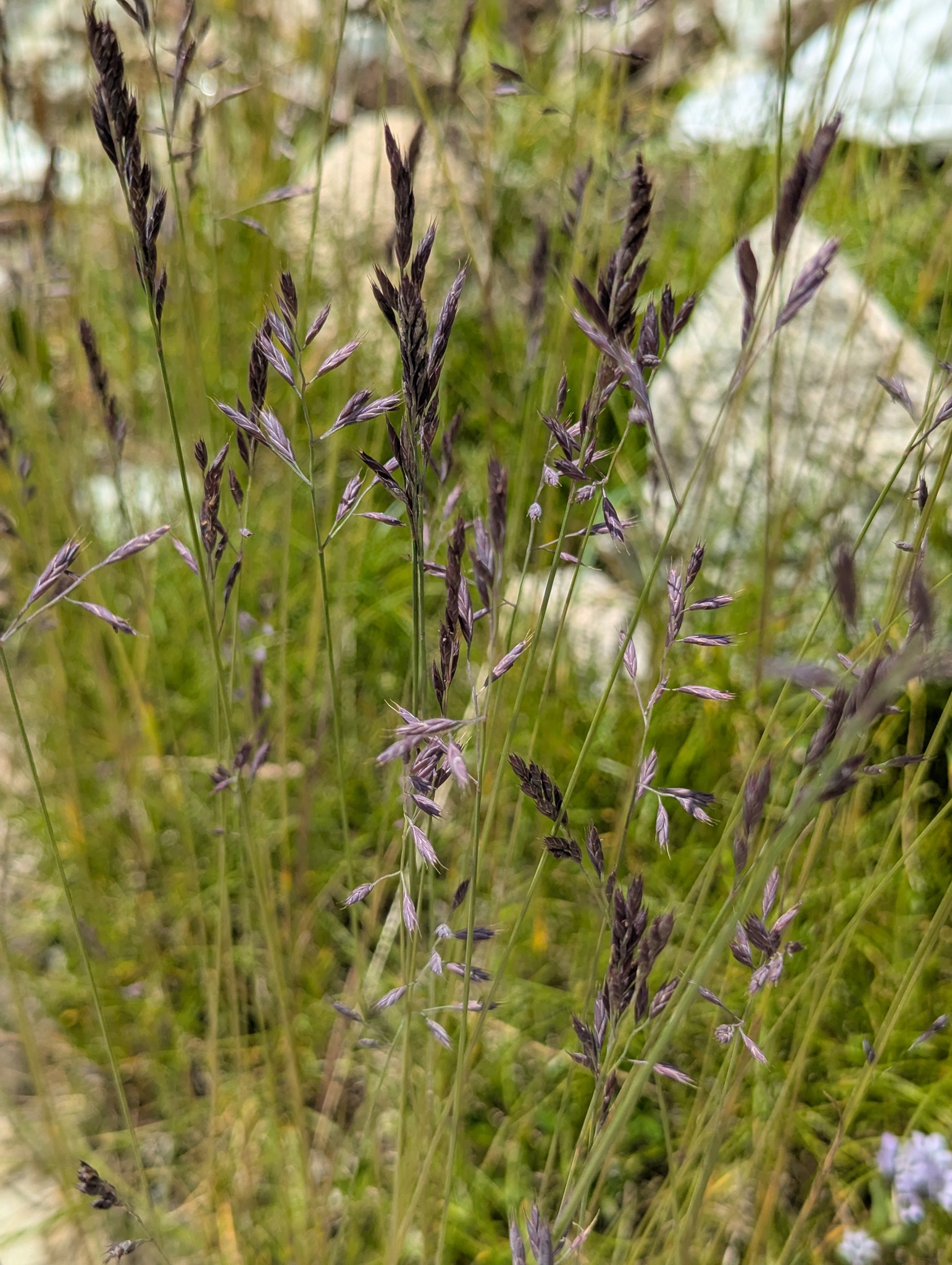
Creeping Red Fescue
Festuca rubra
Also listed as Festuca alpigena, Festuca daghestanica
Also known as Red Fescue, Creeping Fescue
Climate Match for your location
See how well Creeping Red Fescue grows in your area.
Enter your ZIP code and we'll show you how this plant fits your local climate.
A fine-textured, shade-tolerant grass with reddish leaf sheaths that form a dense, creeping mat. Excellent for shaded lawns and groundcover in areas where sun-loving grasses struggle.
Why grow it
Creeping red fescue outperforms most lawn grasses in dense shade and tolerates mowing heights between 2.5 and 3.5 inches where other species thin. It establishes a stable root system that helps prevent erosion on slopes and compacted soils, making it useful in permaculture systems where ground stabilization matters more than aesthetic uniformity.
Watch out for
In warm climates (USDA zones 8 and warmer), creeping red fescue may struggle during extended heat and drought, requiring supplemental irrigation that other species might avoid. Dense thatch can accumulate over time, so periodic dethatching or scarification keeps the stand productive and reduces disease pressure.
Overview
- Form
- Growth Rate
- Size
- Dormancy
- Family
- Poaceae
Native to the United States
Native Range
Europe and temperate Asia
Native to: Alaska, Alabama, Arizona, California, Connecticut, District of Columbia, Delaware, Georgia, Iowa, Idaho, Illinois, Indiana, Kentucky, Massachusetts, Maryland, Maine, Michigan, Minnesota, Missouri, Montana, North Carolina, North Dakota, Nebraska, New Hampshire, New Jersey, New Mexico, Nevada, New York, Ohio, Oregon, Pennsylvania, Rhode Island, South Carolina, Tennessee, Texas, Utah, Virginia, Vermont, Washington, Wisconsin, West Virginia, Wyoming
Seasonality
Season of Interest
Ground cover
Low spreading plants that carpet the soil.
Succession Role
Tolerances & Soil
Flood Tolerance
Deer Resistance
Inferred from USDA browse palatability
pH Range
Soil Texture
Establishment & Care
- Establishment
- Maintenance
- Propagation
A fine-textured, shade-tolerant grass with reddish leaf sheaths that form a dense, creeping mat. Excellent for shaded lawns and groundcover in areas where sun-loving grasses struggle.
Climate Match for your location
See how well Creeping Red Fescue grows in your area.
Enter your ZIP code and we'll show you how this plant fits your local climate.
Why grow it
Creeping red fescue outperforms most lawn grasses in dense shade and tolerates mowing heights between 2.5 and 3.5 inches where other species thin. It establishes a stable root system that helps prevent erosion on slopes and compacted soils, making it useful in permaculture systems where ground stabilization matters more than aesthetic uniformity.
Watch out for
In warm climates (USDA zones 8 and warmer), creeping red fescue may struggle during extended heat and drought, requiring supplemental irrigation that other species might avoid. Dense thatch can accumulate over time, so periodic dethatching or scarification keeps the stand productive and reduces disease pressure.
Overview
- Form
- Growth Rate
- Size
- Dormancy
- Family
- Poaceae
Native to the United States
Native Range
Europe and temperate Asia
Native to: Alaska, Alabama, Arizona, California, Connecticut, District of Columbia, Delaware, Georgia, Iowa, Idaho, Illinois, Indiana, Kentucky, Massachusetts, Maryland, Maine, Michigan, Minnesota, Missouri, Montana, North Carolina, North Dakota, Nebraska, New Hampshire, New Jersey, New Mexico, Nevada, New York, Ohio, Oregon, Pennsylvania, Rhode Island, South Carolina, Tennessee, Texas, Utah, Virginia, Vermont, Washington, Wisconsin, West Virginia, Wyoming
Seasonality
Season of Interest
Ground cover
Low spreading plants that carpet the soil.
Succession Role
Tolerances & Soil
Flood Tolerance
Deer Resistance
Inferred from USDA browse palatability
pH Range
Soil Texture
Establishment & Care
- Establishment
- Maintenance
- Propagation
Similar ground covers you might consider:
Enter your ZIP code to see top native species and strong climate fits for you.