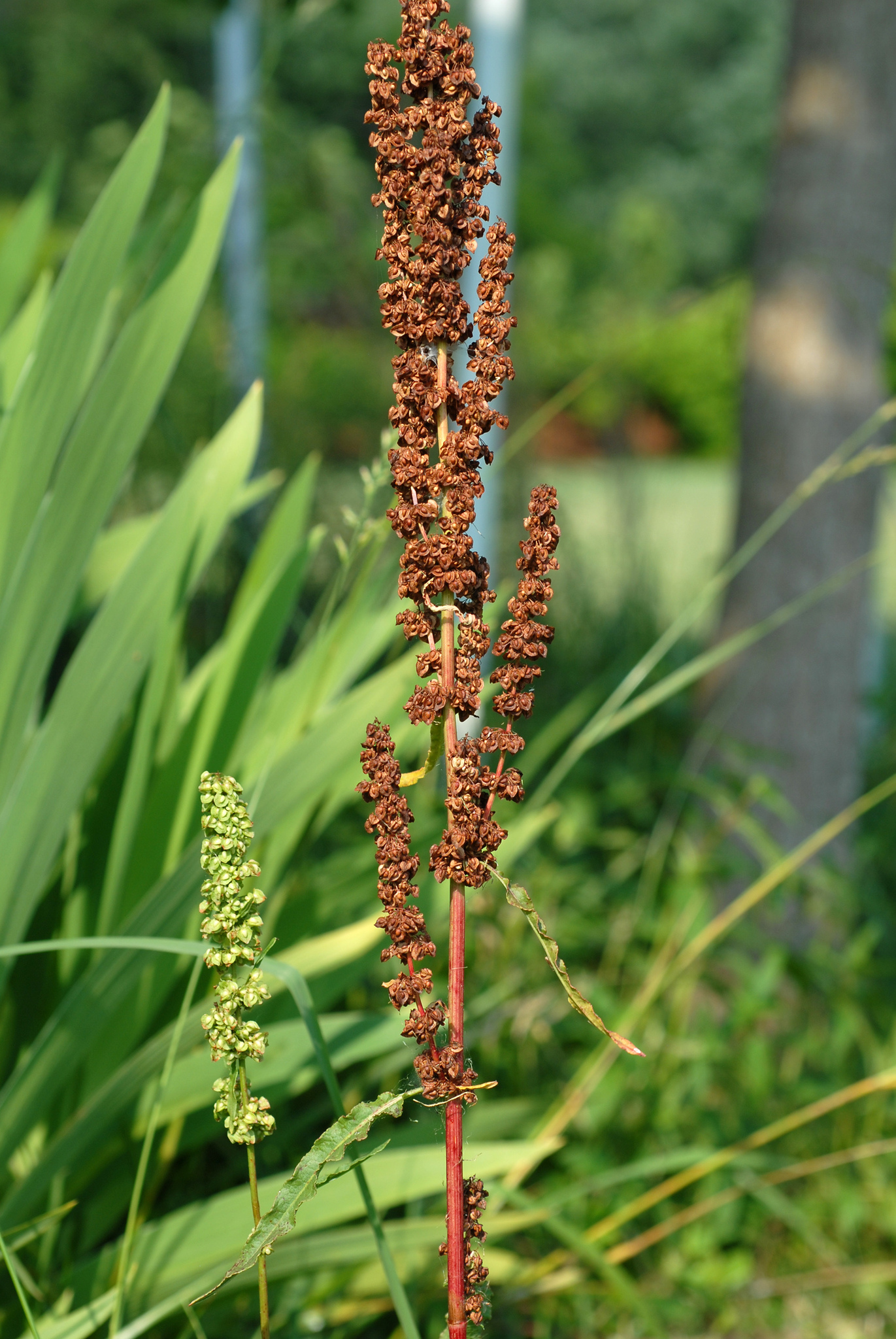
Curled Dock
Rumex crispus
Also listed as Lapathum crispum
Also known as Curly Dock, Yellow Dock, Narrow Dock
Climate Match for your location
See how well Curled Dock grows in your area.
Enter your ZIP code and we'll show you how this plant fits your local climate.
Curled dock is a vigorous perennial weed with distinctive crinkled, wavy-edged leaves and tall spikes of small greenish flowers that turn reddish-brown. It readily self-seeds and is common in disturbed areas, pastures, and roadsides.
Why grow it
Curled dock offers a deep taproot that can break up compacted soil and access moisture unavailable to shallow-rooted species, making it useful for soil remediation in degraded sites. The plant accumulates minerals and can be used as a dynamic accumulator in compost systems. Compared to other docks, its distinctive wavy foliage is visually distinctive, and it tolerates a wider range of soil conditions than many cultivated greens.
Watch out for
Curled dock establishes easily and spreads prolifically from seed, so it requires deliberate management to prevent it from dominating intended plantings. The seed remains viable in soil for years, making complete removal difficult once established. Livestock may avoid the plant due to its oxalic acid content, reducing forage value in pasture settings.
Overview
- Form
- Growth Rate
- Size
- Dormancy
- Family
- Polygonaceae
Native Range
Europe
Seasonality
Bloom Season
Harvest Season
Edible Parts
Season of Interest
Herb
Soft non-woody plants of the field layer.
Succession Role
Tolerances & Soil
Establishment & Care
- Establishment
- Maintenance
- Propagation
Curled dock is a vigorous perennial weed with distinctive crinkled, wavy-edged leaves and tall spikes of small greenish flowers that turn reddish-brown. It readily self-seeds and is common in disturbed areas, pastures, and roadsides.
Climate Match for your location
See how well Curled Dock grows in your area.
Enter your ZIP code and we'll show you how this plant fits your local climate.
Why grow it
Curled dock offers a deep taproot that can break up compacted soil and access moisture unavailable to shallow-rooted species, making it useful for soil remediation in degraded sites. The plant accumulates minerals and can be used as a dynamic accumulator in compost systems. Compared to other docks, its distinctive wavy foliage is visually distinctive, and it tolerates a wider range of soil conditions than many cultivated greens.
Watch out for
Curled dock establishes easily and spreads prolifically from seed, so it requires deliberate management to prevent it from dominating intended plantings. The seed remains viable in soil for years, making complete removal difficult once established. Livestock may avoid the plant due to its oxalic acid content, reducing forage value in pasture settings.
Overview
- Form
- Growth Rate
- Size
- Dormancy
- Family
- Polygonaceae
Native Range
Europe
Seasonality
Bloom Season
Harvest Season
Edible Parts
Season of Interest
Herb
Soft non-woody plants of the field layer.
Succession Role
Tolerances & Soil
Establishment & Care
- Establishment
- Maintenance
- Propagation
Similar herbs you might consider:
Enter your ZIP code to see top native species and strong climate fits for you.