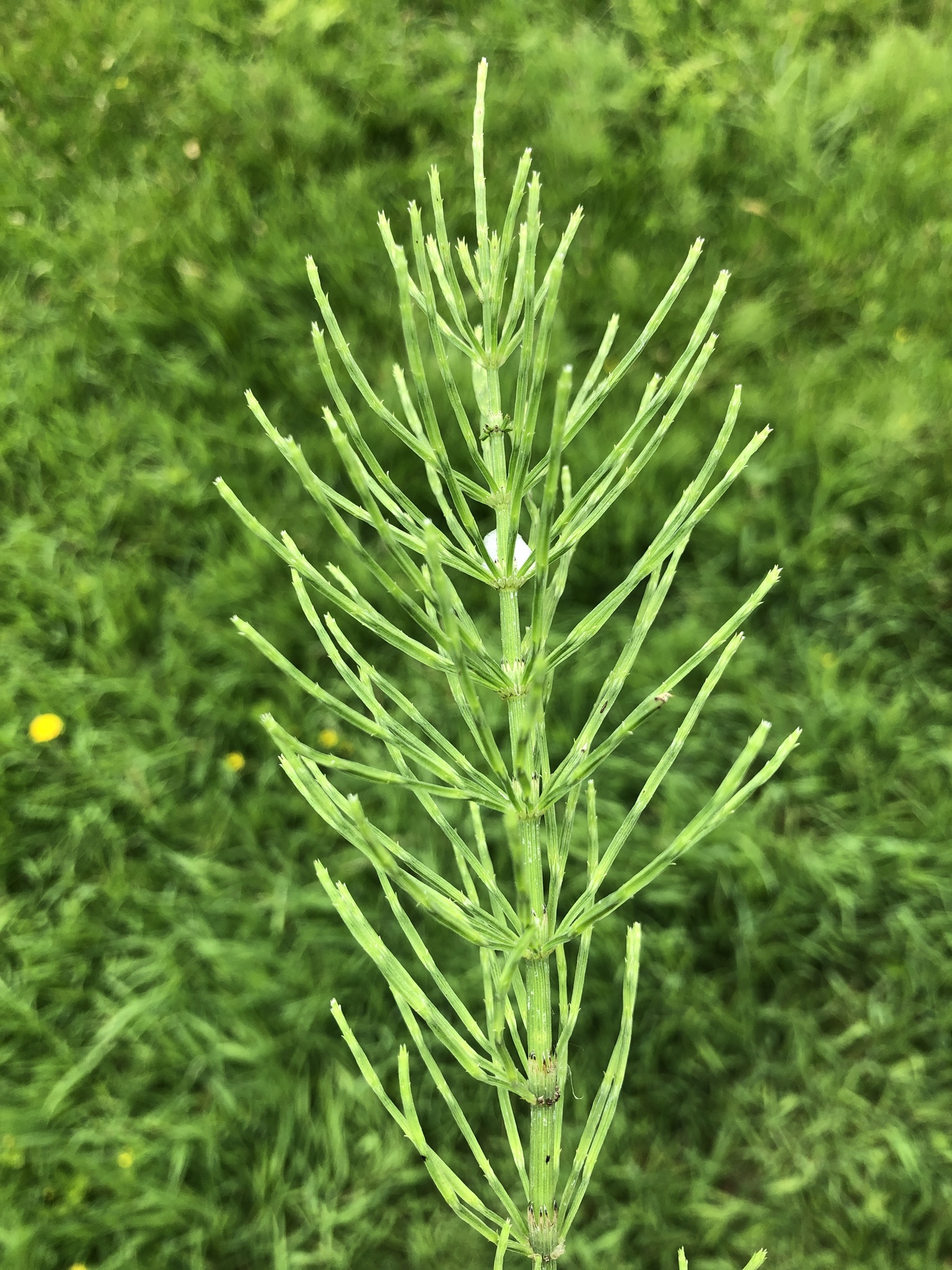
Field Horsetail
Equisetum arvense
Also listed as Equisetum calderi, Allostelites arvensis
Also known as Common Horsetail, Common Field Horsetail, Scouring Rush
Climate Match for your location
See how well Field Horsetail grows in your area.
Enter your ZIP code and we'll show you how this plant fits your local climate.
Field horsetail is a primitive, non-flowering perennial with jointed, hollow green stems and whorled branches, resembling miniature evergreen trees. It is highly invasive and persistent, thriving in wet areas and spreading rapidly through underground rhizomes.
Why grow it
Field horsetail offers a distinctive architectural form with jointed, segmented stems that differ markedly from flowering perennials and are useful for textural contrast in wet-site plantings. Its deep rhizomatous root system can help stabilize soil in riparian areas and poorly drained zones where few other perennials establish reliably. Compared to ornamental grasses in similar niches, horsetail's primitive branching structure and fine silica content have historical ethnobotanical applications, though modern cultivation is typically limited to contained water gardens or wetland restoration projects.
Watch out for
Field horsetail thrives in consistently moist or waterlogged soils and can be difficult to control once established, making it better suited to designated wetland areas than mixed plantings. Its silica-rich stems are abrasive and may require protective gloves during handling. Manual removal is often ineffective due to deep rhizomes, so containment strategies (such as barriers or dedicated growing zones) are typically more practical than eradication attempts.
Overview
- Form
- Growth Rate
- Size
- Dormancy
- Family
- Equisetaceae
Native to the United States
Native Range
Northern Hemisphere temperate and boreal regions
Native to: Alaska, Alabama, Arkansas, Arizona, California, Colorado, Connecticut, District of Columbia, Delaware, Georgia, Iowa, Idaho, Illinois, Indiana, Kansas, Kentucky, Massachusetts, Maryland, Maine, Michigan, Minnesota, Missouri, Mississippi, Montana, North Carolina, North Dakota, Nebraska, New Hampshire, New Jersey, New Mexico, Nevada, New York, Ohio, Oklahoma, Oregon, Pennsylvania, Rhode Island, South Carolina, South Dakota, Tennessee, Texas, Utah, Virginia, Vermont, Washington, Wisconsin, West Virginia, Wyoming
Seasonality
Season of Interest
Ground cover
Low spreading plants that carpet the soil.
Succession Role
Tolerances & Soil
Flood Tolerance
Deer Resistance
Inferred from USDA browse palatability
pH Range
Soil Texture
Establishment & Care
- Establishment
- Maintenance
- Propagation
Field horsetail is a primitive, non-flowering perennial with jointed, hollow green stems and whorled branches, resembling miniature evergreen trees. It is highly invasive and persistent, thriving in wet areas and spreading rapidly through underground rhizomes.
Climate Match for your location
See how well Field Horsetail grows in your area.
Enter your ZIP code and we'll show you how this plant fits your local climate.
Why grow it
Field horsetail offers a distinctive architectural form with jointed, segmented stems that differ markedly from flowering perennials and are useful for textural contrast in wet-site plantings. Its deep rhizomatous root system can help stabilize soil in riparian areas and poorly drained zones where few other perennials establish reliably. Compared to ornamental grasses in similar niches, horsetail's primitive branching structure and fine silica content have historical ethnobotanical applications, though modern cultivation is typically limited to contained water gardens or wetland restoration projects.
Watch out for
Field horsetail thrives in consistently moist or waterlogged soils and can be difficult to control once established, making it better suited to designated wetland areas than mixed plantings. Its silica-rich stems are abrasive and may require protective gloves during handling. Manual removal is often ineffective due to deep rhizomes, so containment strategies (such as barriers or dedicated growing zones) are typically more practical than eradication attempts.
Overview
- Form
- Growth Rate
- Size
- Dormancy
- Family
- Equisetaceae
Native to the United States
Native Range
Northern Hemisphere temperate and boreal regions
Native to: Alaska, Alabama, Arkansas, Arizona, California, Colorado, Connecticut, District of Columbia, Delaware, Georgia, Iowa, Idaho, Illinois, Indiana, Kansas, Kentucky, Massachusetts, Maryland, Maine, Michigan, Minnesota, Missouri, Mississippi, Montana, North Carolina, North Dakota, Nebraska, New Hampshire, New Jersey, New Mexico, Nevada, New York, Ohio, Oklahoma, Oregon, Pennsylvania, Rhode Island, South Carolina, South Dakota, Tennessee, Texas, Utah, Virginia, Vermont, Washington, Wisconsin, West Virginia, Wyoming
Seasonality
Season of Interest
Ground cover
Low spreading plants that carpet the soil.
Succession Role
Tolerances & Soil
Flood Tolerance
Deer Resistance
Inferred from USDA browse palatability
pH Range
Soil Texture
Establishment & Care
- Establishment
- Maintenance
- Propagation
Similar ground covers you might consider:
Enter your ZIP code to see top native species and strong climate fits for you.