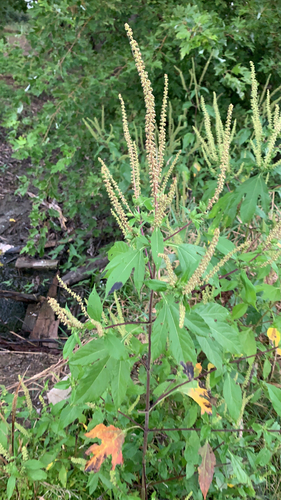
Giant Ragweed
Ambrosia trifida
Also listed as Ambrosia aptera, Ambrosia integrifolia
Also known as Great Ragweed, Tall Ragweed, Horse-cane
Climate Match for your location
See how well Giant Ragweed grows in your area.
Enter your ZIP code and we'll show you how this plant fits your local climate.
Giant ragweed is a tall, fast-growing annual weed with coarse foliage and inconspicuous green flowers that produce large amounts of allergenic pollen in late summer and fall. It thrives in disturbed areas and is considered a serious agricultural and environmental weed across much of North America.
Why grow it
Giant ragweed is not typically grown intentionally in permaculture systems. It does demonstrate rapid biomass accumulation and can be useful as a study subject for understanding weed ecology and allelopathic plant interactions, but superior fast-growing cover crops and nitrogen accumulators exist for most design goals. If encountered during land preparation, it can indicate soil disturbance and nutrient availability worth assessing for site planning.
Watch out for
Ragweed management requires consistent monitoring during its peak growth season, as plants reach flowering size quickly and spread viable seed over considerable distances. Hand removal becomes increasingly difficult once plants are established and woody at the base, making early intervention more practical than delayed control efforts.
Overview
- Form
- Growth Rate
- Size
- Dormancy
- Family
- Asteraceae
Native to the United States
Native Range
Eastern North America
Native to: Alabama, Arkansas, Arizona, California, Colorado, Connecticut, District of Columbia, Delaware, Florida, Georgia, Iowa, Idaho, Illinois, Indiana, Kansas, Kentucky, Louisiana, Massachusetts, Maryland, Maine, Michigan, Minnesota, Missouri, Mississippi, Montana, North Carolina, North Dakota, Nebraska, New Hampshire, New Jersey, New Mexico, New York, Ohio, Oklahoma, Oregon, Pennsylvania, Rhode Island, South Carolina, South Dakota, Tennessee, Texas, Utah, Virginia, Vermont, Washington, Wisconsin, West Virginia, Wyoming
Seasonality
Bloom Season
Season of Interest
Herb
Soft non-woody plants of the field layer.
Succession Role
Tolerances & Soil
Establishment & Care
- Establishment
- Maintenance
- Propagation
Giant ragweed is a tall, fast-growing annual weed with coarse foliage and inconspicuous green flowers that produce large amounts of allergenic pollen in late summer and fall. It thrives in disturbed areas and is considered a serious agricultural and environmental weed across much of North America.
Climate Match for your location
See how well Giant Ragweed grows in your area.
Enter your ZIP code and we'll show you how this plant fits your local climate.
Why grow it
Giant ragweed is not typically grown intentionally in permaculture systems. It does demonstrate rapid biomass accumulation and can be useful as a study subject for understanding weed ecology and allelopathic plant interactions, but superior fast-growing cover crops and nitrogen accumulators exist for most design goals. If encountered during land preparation, it can indicate soil disturbance and nutrient availability worth assessing for site planning.
Watch out for
Ragweed management requires consistent monitoring during its peak growth season, as plants reach flowering size quickly and spread viable seed over considerable distances. Hand removal becomes increasingly difficult once plants are established and woody at the base, making early intervention more practical than delayed control efforts.
Overview
- Form
- Growth Rate
- Size
- Dormancy
- Family
- Asteraceae
Native to the United States
Native Range
Eastern North America
Native to: Alabama, Arkansas, Arizona, California, Colorado, Connecticut, District of Columbia, Delaware, Florida, Georgia, Iowa, Idaho, Illinois, Indiana, Kansas, Kentucky, Louisiana, Massachusetts, Maryland, Maine, Michigan, Minnesota, Missouri, Mississippi, Montana, North Carolina, North Dakota, Nebraska, New Hampshire, New Jersey, New Mexico, New York, Ohio, Oklahoma, Oregon, Pennsylvania, Rhode Island, South Carolina, South Dakota, Tennessee, Texas, Utah, Virginia, Vermont, Washington, Wisconsin, West Virginia, Wyoming
Seasonality
Bloom Season
Season of Interest
Herb
Soft non-woody plants of the field layer.
Succession Role
Tolerances & Soil
Establishment & Care
- Establishment
- Maintenance
- Propagation
Similar herbs you might consider:
Enter your ZIP code to see top native species and strong climate fits for you.