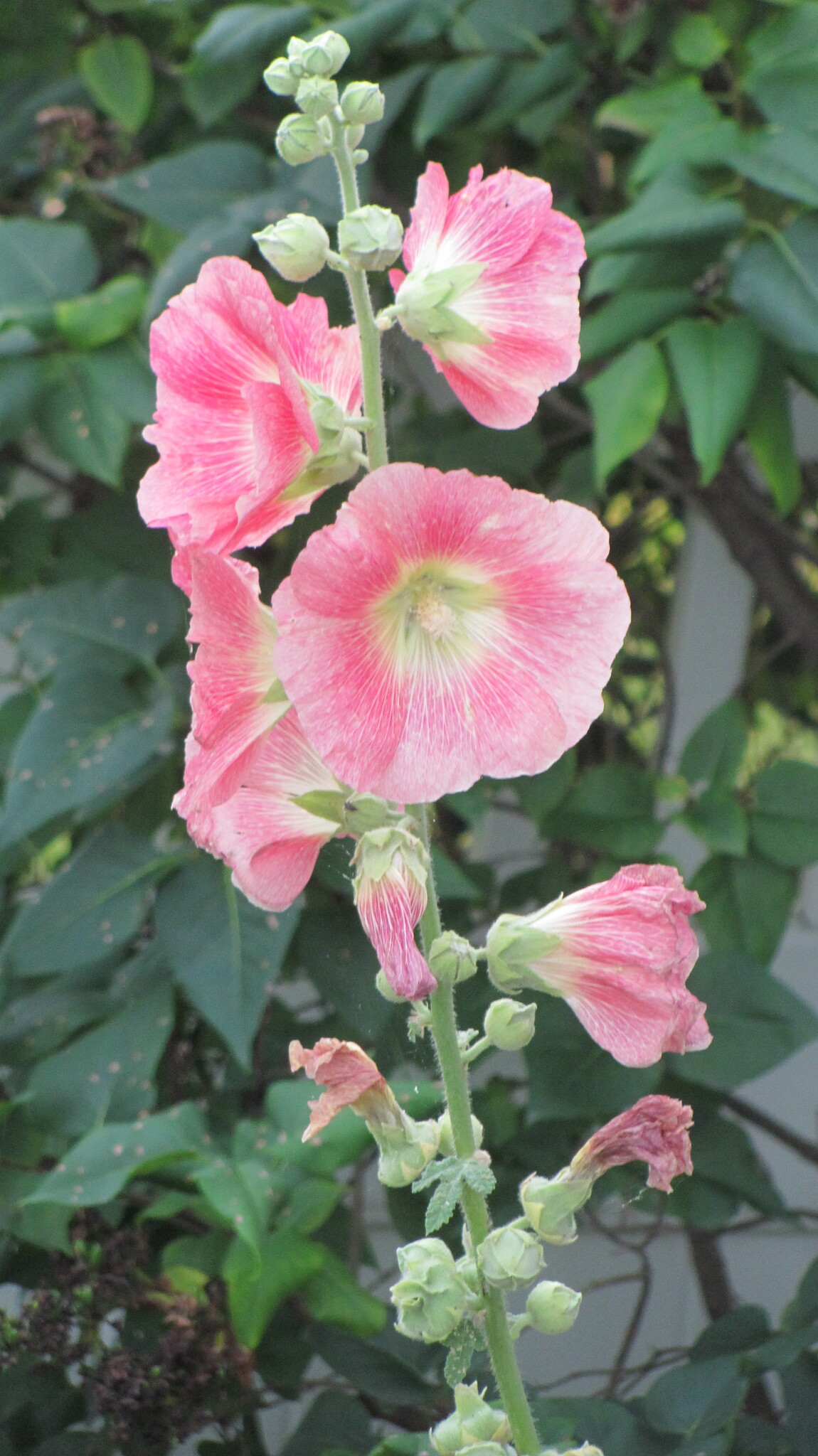
Hollyhock
Alcea rosea
Also listed as Althaea rosea, Malva rosea
Also known as Common Hollyhock, Garden Hollyhock, Black Hollyhock
Climate Match for your location
See how well Hollyhock grows in your area.
Enter your ZIP code and we'll show you how this plant fits your local climate.
Hollyhock is a classic cottage garden plant with tall spikes of large, showy flowers in pink, red, yellow, white, and purple. Though often grown as a biennial, it can self-seed readily and return year after year.
Why grow it
Hollyhock provides reliable vertical interest in mixed borders and cottage gardens with minimal maintenance once established. Unlike many tall ornamentals, it tolerates poor soil and drought once rooted, making it useful for low-input landscapes. The range of flower colors allows for layered planting combinations, and its biennial-to-perennial behavior means successive generations can occupy the same space with minimal intervention.
Watch out for
Plants may require staking in windy locations or rich soil that encourages excessive vegetative growth. Rust fungus can be problematic in humid regions, particularly on lower foliage, though air circulation around plants reduces incidence. Self-seeding can be vigorous in suitable conditions, so deadheading before seed set helps prevent unwanted seedlings if desired.
Overview
- Form
- Growth Rate
- Size
- Dormancy
- Family
- Malvaceae
Native Range
Eastern Mediterranean and Asia Minor
Seasonality
Bloom Season
Harvest Season
Edible Parts
Season of Interest
Herb
Soft non-woody plants of the field layer.
Succession Role
Tolerances & Soil
Establishment & Care
- Establishment
- Maintenance
- Propagation
Hollyhock is a classic cottage garden plant with tall spikes of large, showy flowers in pink, red, yellow, white, and purple. Though often grown as a biennial, it can self-seed readily and return year after year.
Climate Match for your location
See how well Hollyhock grows in your area.
Enter your ZIP code and we'll show you how this plant fits your local climate.
Why grow it
Hollyhock provides reliable vertical interest in mixed borders and cottage gardens with minimal maintenance once established. Unlike many tall ornamentals, it tolerates poor soil and drought once rooted, making it useful for low-input landscapes. The range of flower colors allows for layered planting combinations, and its biennial-to-perennial behavior means successive generations can occupy the same space with minimal intervention.
Watch out for
Plants may require staking in windy locations or rich soil that encourages excessive vegetative growth. Rust fungus can be problematic in humid regions, particularly on lower foliage, though air circulation around plants reduces incidence. Self-seeding can be vigorous in suitable conditions, so deadheading before seed set helps prevent unwanted seedlings if desired.
Overview
- Form
- Growth Rate
- Size
- Dormancy
- Family
- Malvaceae
Native Range
Eastern Mediterranean and Asia Minor
Seasonality
Bloom Season
Harvest Season
Edible Parts
Season of Interest
Herb
Soft non-woody plants of the field layer.
Succession Role
Tolerances & Soil
Establishment & Care
- Establishment
- Maintenance
- Propagation
Similar herbs you might consider:
Enter your ZIP code to see top native species and strong climate fits for you.