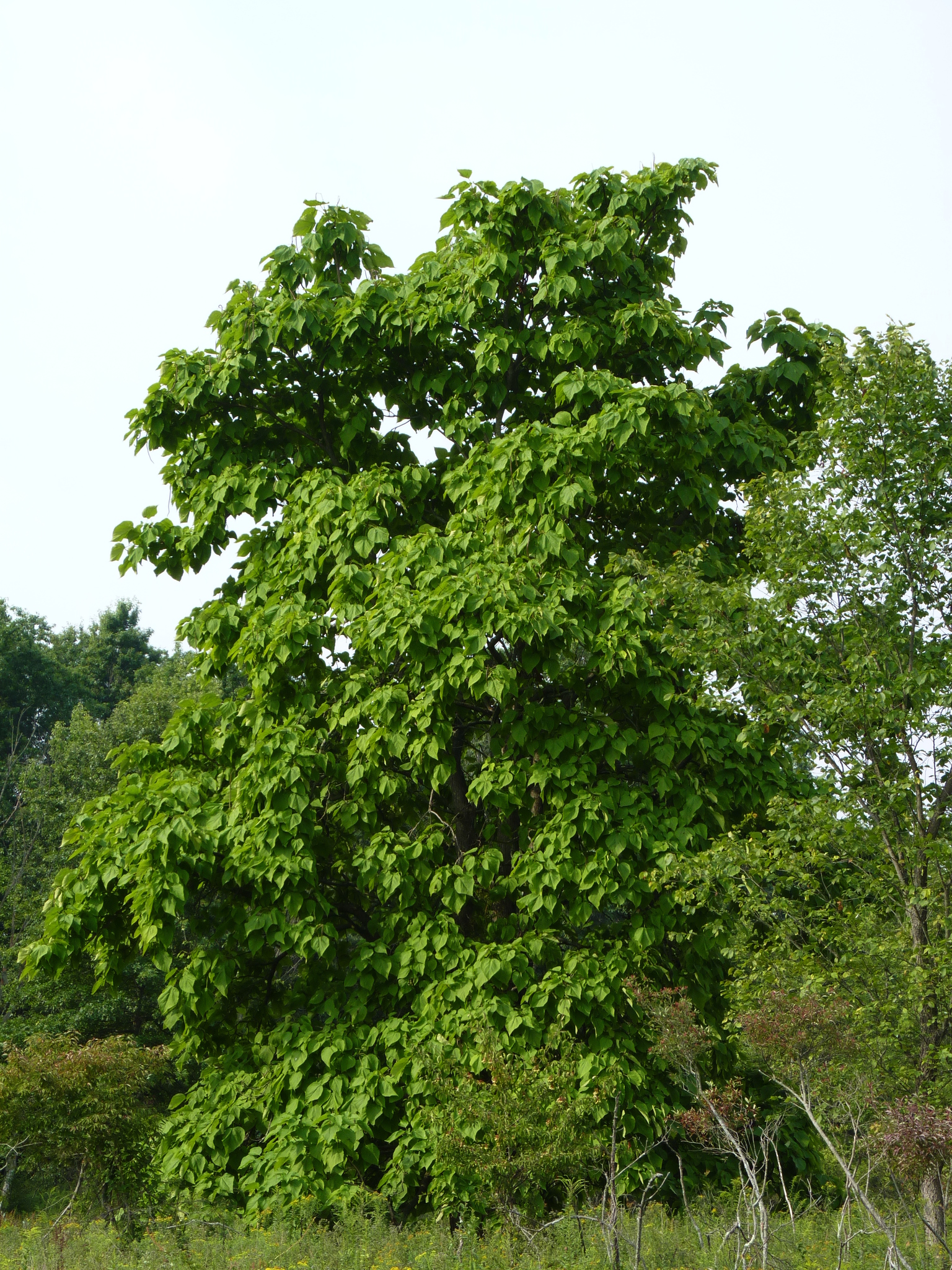
Northern Catalpa
Catalpa speciosa
Also listed as Catalpa cordifolia
Also known as Cigar Tree, Catawba, Caterpillar Tree
Climate Match for your location
See how well Northern Catalpa grows in your area.
Enter your ZIP code and we'll show you how this plant fits your local climate.
A large deciduous shade tree with fragrant white and purple flowers in late spring, followed by long bean-like seed pods. It grows quickly and is valued for its dramatic foliage and ornamental appeal.
Why grow it
Northern catalpa is a fast-growing shade tree that produces larger flowers and seed pods than most comparable native species, making it distinctive for ornamental interest. It tolerates a wider range of soil conditions than many shade trees and establishes quickly, useful where rapid canopy development is desired. Its coarse texture and bold foliage provide visual contrast in landscapes dominated by finer-textured trees.
Watch out for
The tree produces prolific self-seeding in suitable climates, so seedlings may require management in subsequent years. Its brittle wood is susceptible to storm damage in exposed locations, and heavy branching can create dense shade that limits understory growth beneath the canopy. Late leaf emergence means the tree appears bare well into spring, which some gardeners find visually awkward during that season.
Overview
- Form
- Growth Rate
- Size
- Dormancy
- Family
- Bignoniaceae
Native to the United States
Native Range
Central United States
Native to: Alabama, Arkansas, Connecticut, District of Columbia, Georgia, Iowa, Illinois, Indiana, Kansas, Kentucky, Louisiana, Massachusetts, Michigan, Missouri, Mississippi, North Carolina, North Dakota, Nebraska, New Hampshire, New Mexico, New York, Ohio, Oklahoma, Pennsylvania, South Carolina, South Dakota, Tennessee, Texas, Utah, Virginia, West Virginia
Seasonality
Bloom Season
Season of Interest
Canopy
The tallest trees that form the overstory.
Succession Role
Tolerances & Soil
Flood Tolerance
Deer Resistance
Inferred from USDA browse palatability
pH Range
Soil Texture
Establishment & Care
- Establishment
- Maintenance
- Propagation
A large deciduous shade tree with fragrant white and purple flowers in late spring, followed by long bean-like seed pods. It grows quickly and is valued for its dramatic foliage and ornamental appeal.
Climate Match for your location
See how well Northern Catalpa grows in your area.
Enter your ZIP code and we'll show you how this plant fits your local climate.
Why grow it
Northern catalpa is a fast-growing shade tree that produces larger flowers and seed pods than most comparable native species, making it distinctive for ornamental interest. It tolerates a wider range of soil conditions than many shade trees and establishes quickly, useful where rapid canopy development is desired. Its coarse texture and bold foliage provide visual contrast in landscapes dominated by finer-textured trees.
Watch out for
The tree produces prolific self-seeding in suitable climates, so seedlings may require management in subsequent years. Its brittle wood is susceptible to storm damage in exposed locations, and heavy branching can create dense shade that limits understory growth beneath the canopy. Late leaf emergence means the tree appears bare well into spring, which some gardeners find visually awkward during that season.
Overview
- Form
- Growth Rate
- Size
- Dormancy
- Family
- Bignoniaceae
Native to the United States
Native Range
Central United States
Native to: Alabama, Arkansas, Connecticut, District of Columbia, Georgia, Iowa, Illinois, Indiana, Kansas, Kentucky, Louisiana, Massachusetts, Michigan, Missouri, Mississippi, North Carolina, North Dakota, Nebraska, New Hampshire, New Mexico, New York, Ohio, Oklahoma, Pennsylvania, South Carolina, South Dakota, Tennessee, Texas, Utah, Virginia, West Virginia
Seasonality
Bloom Season
Season of Interest
Canopy
The tallest trees that form the overstory.
Succession Role
Tolerances & Soil
Flood Tolerance
Deer Resistance
Inferred from USDA browse palatability
pH Range
Soil Texture
Establishment & Care
- Establishment
- Maintenance
- Propagation
Similar canopy trees you might consider:
Enter your ZIP code to see top native species and strong climate fits for you.