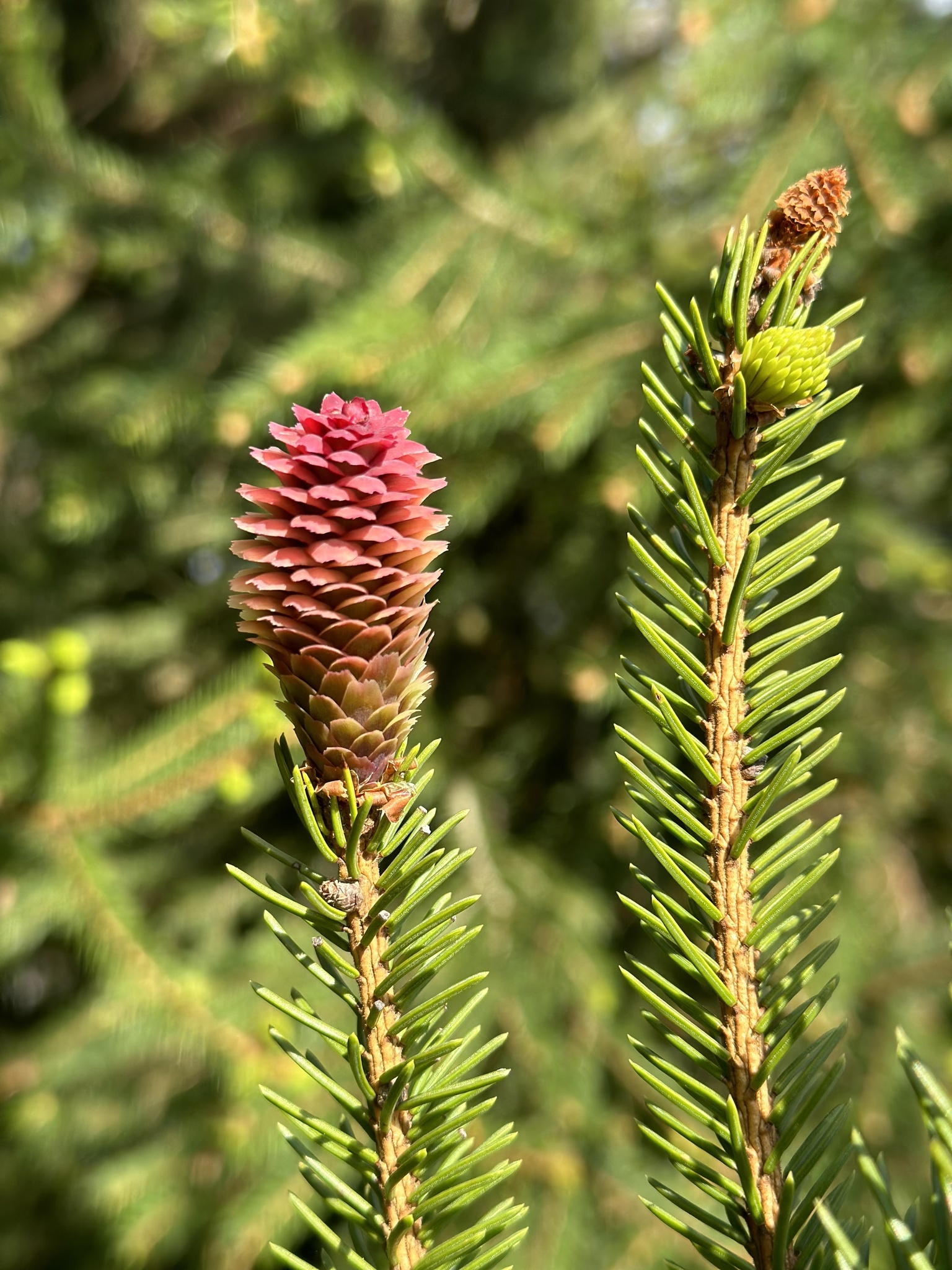
Norway Spruce
Picea abies
Also listed as Abies abies, Abies communis
Also known as Common Spruce, Spruce Fir
Climate Match for your location
See how well Norway Spruce grows in your area.
Enter your ZIP code and we'll show you how this plant fits your local climate.
A tall, conical evergreen tree with dark green needles and drooping branches, commonly used as an ornamental or Christmas tree. It prefers cool climates and moist, well-drained soil.
Why grow it
Norway spruce grows faster and taller than many comparable conifers, making it useful for windbreaks or timber in cool regions. Its dense branching habit provides better structure for wildlife shelter than columnar alternatives. The species tolerates a wider range of soil conditions than some ornamental spruces while maintaining reliable form.
Watch out for
In warmer climates or during extended dry periods, this tree becomes susceptible to spider mites and needle drop, requiring supplemental watering to establish. Branch breakage can occur under heavy wet snow or ice loads, so periodic light pruning may be needed in exposed sites.
Overview
- Form
- Growth Rate
- Size
- Dormancy
- Family
- Pinaceae
Native Range
Northern and Central Europe
Seasonality
Season of Interest
Canopy
The tallest trees that form the overstory.
Succession Role
Tolerances & Soil
Flood Tolerance
Deer Resistance
Inferred from USDA browse palatability
pH Range
Soil Texture
Establishment & Care
- Establishment
- Maintenance
- Propagation
A tall, conical evergreen tree with dark green needles and drooping branches, commonly used as an ornamental or Christmas tree. It prefers cool climates and moist, well-drained soil.
Climate Match for your location
See how well Norway Spruce grows in your area.
Enter your ZIP code and we'll show you how this plant fits your local climate.
Why grow it
Norway spruce grows faster and taller than many comparable conifers, making it useful for windbreaks or timber in cool regions. Its dense branching habit provides better structure for wildlife shelter than columnar alternatives. The species tolerates a wider range of soil conditions than some ornamental spruces while maintaining reliable form.
Watch out for
In warmer climates or during extended dry periods, this tree becomes susceptible to spider mites and needle drop, requiring supplemental watering to establish. Branch breakage can occur under heavy wet snow or ice loads, so periodic light pruning may be needed in exposed sites.
Overview
- Form
- Growth Rate
- Size
- Dormancy
- Family
- Pinaceae
Native Range
Northern and Central Europe
Seasonality
Season of Interest
Canopy
The tallest trees that form the overstory.
Succession Role
Tolerances & Soil
Flood Tolerance
Deer Resistance
Inferred from USDA browse palatability
pH Range
Soil Texture
Establishment & Care
- Establishment
- Maintenance
- Propagation
Similar canopy trees you might consider:
Enter your ZIP code to see top native species and strong climate fits for you.