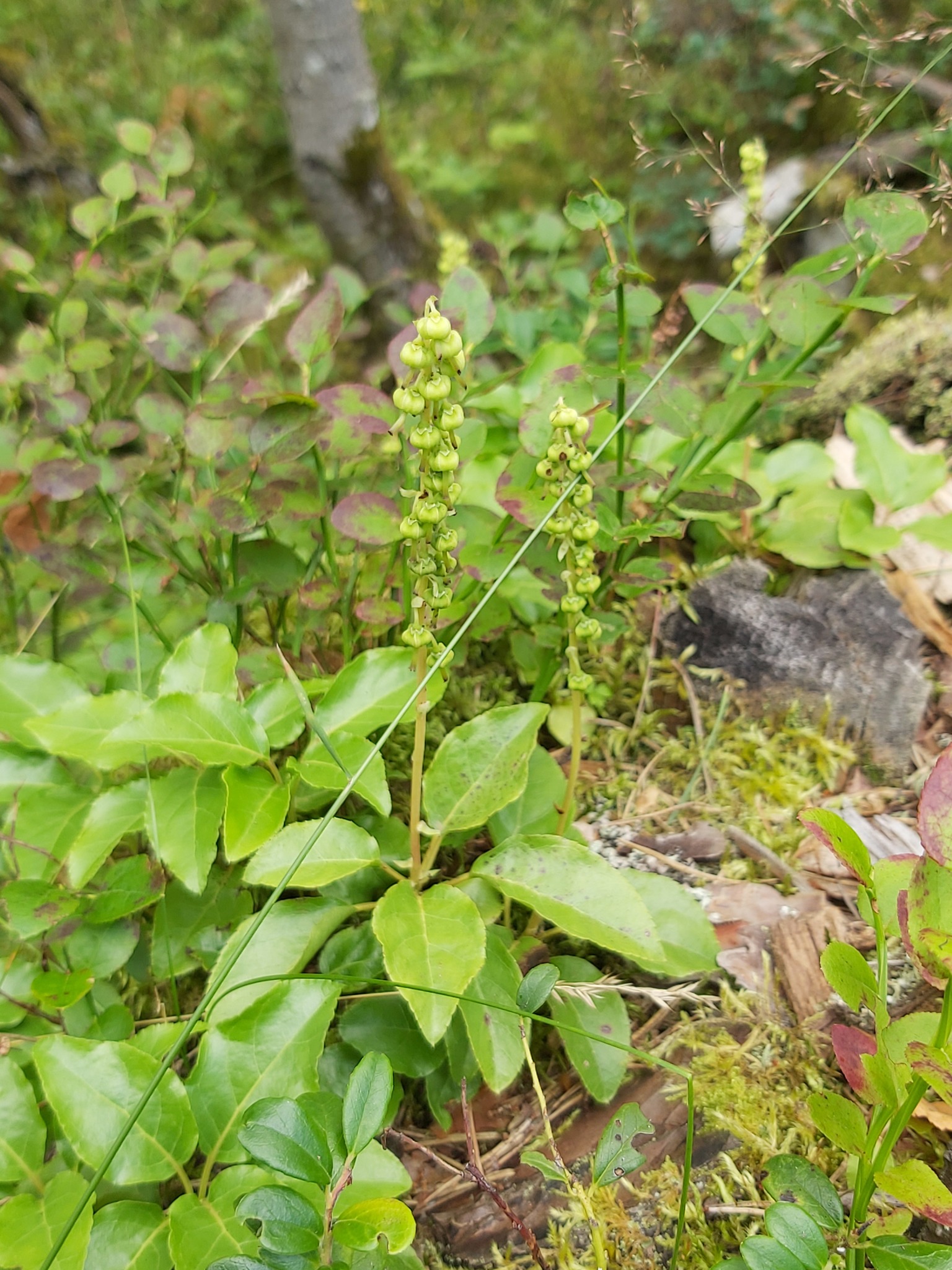
One-sided Wintergreen
Orthilia secunda
Also listed as Pyrola secunda, Ramischia elatior
Also known as Sidebells Wintergreen, Serrated Wintergreen, One-sided Pyrola
Climate Match for your location
See how well One-sided Wintergreen grows in your area.
Enter your ZIP code and we'll show you how this plant fits your local climate.
A delicate, low-growing evergreen perennial with one-sided spikes of small white or pale pink flowers. Commonly found in cool, moist woodlands and is valued for its subtle shade-garden presence.
Why grow it
Orthilia secunda occupies a narrow ecological niche as a low-growing evergreen groundcover for shaded, acidic woodland conditions where many other perennials struggle. Unlike taller shade plants, its prostrate habit and modest flowering make it useful for understory layering without competing with shrub and tree canopies. The persistent foliage provides winter interest in cool-climate gardens where deciduous groundcovers leave bare soil exposed.
Watch out for
This plant is slow to establish and requires consistent moisture during its first growing season, making it unsuitable for neglected garden areas. Success depends heavily on replicating its native habitat conditions (cool temperatures, high humidity, acidic soil), so performance often varies unpredictably outside these parameters even when basic care guidelines are followed.
Overview
- Form
- Growth Rate
- Size
- Dormancy
- Family
- Ericaceae
Native to the United States
Native Range
Northern Hemisphere (North America, Europe, Asia)
Native to: Alaska, Arizona, California, Colorado, Connecticut, District of Columbia, Delaware, Iowa, Idaho, Illinois, Indiana, Massachusetts, Maryland, Maine, Michigan, Minnesota, Montana, North Dakota, Nebraska, New Hampshire, New Jersey, New Mexico, Nevada, New York, Ohio, Oregon, Pennsylvania, Rhode Island, South Dakota, Utah, Virginia, Vermont, Washington, Wisconsin, Wyoming
Seasonality
Bloom Season
Season of Interest
Herb
Soft non-woody plants of the field layer.
Succession Role
Tolerances & Soil
Establishment & Care
- Establishment
- Maintenance
- Propagation
A delicate, low-growing evergreen perennial with one-sided spikes of small white or pale pink flowers. Commonly found in cool, moist woodlands and is valued for its subtle shade-garden presence.
Climate Match for your location
See how well One-sided Wintergreen grows in your area.
Enter your ZIP code and we'll show you how this plant fits your local climate.
Why grow it
Orthilia secunda occupies a narrow ecological niche as a low-growing evergreen groundcover for shaded, acidic woodland conditions where many other perennials struggle. Unlike taller shade plants, its prostrate habit and modest flowering make it useful for understory layering without competing with shrub and tree canopies. The persistent foliage provides winter interest in cool-climate gardens where deciduous groundcovers leave bare soil exposed.
Watch out for
This plant is slow to establish and requires consistent moisture during its first growing season, making it unsuitable for neglected garden areas. Success depends heavily on replicating its native habitat conditions (cool temperatures, high humidity, acidic soil), so performance often varies unpredictably outside these parameters even when basic care guidelines are followed.
Overview
- Form
- Growth Rate
- Size
- Dormancy
- Family
- Ericaceae
Native to the United States
Native Range
Northern Hemisphere (North America, Europe, Asia)
Native to: Alaska, Arizona, California, Colorado, Connecticut, District of Columbia, Delaware, Iowa, Idaho, Illinois, Indiana, Massachusetts, Maryland, Maine, Michigan, Minnesota, Montana, North Dakota, Nebraska, New Hampshire, New Jersey, New Mexico, Nevada, New York, Ohio, Oregon, Pennsylvania, Rhode Island, South Dakota, Utah, Virginia, Vermont, Washington, Wisconsin, Wyoming
Seasonality
Bloom Season
Season of Interest
Herb
Soft non-woody plants of the field layer.
Succession Role
Tolerances & Soil
Establishment & Care
- Establishment
- Maintenance
- Propagation
Similar herbs you might consider:
Enter your ZIP code to see top native species and strong climate fits for you.