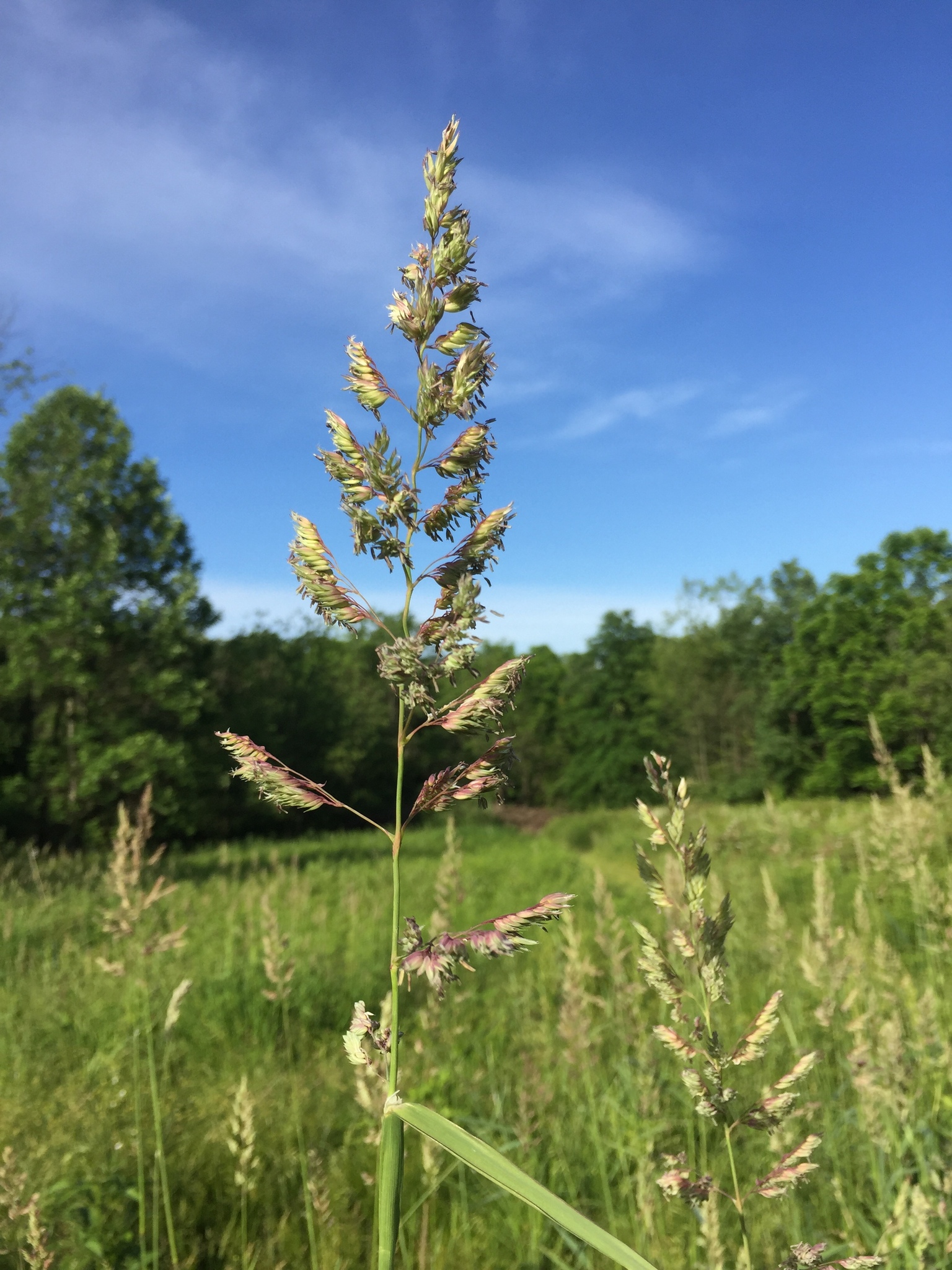
Reed Canary Grass
Phalaris arundinacea
Also listed as Phalaroides arundinacea, Arundo colorata
Also known as Ribbon Grass, Gardener's Garters, Variegated Ribbon Grass
Climate Match for your location
See how well Reed Canary Grass grows in your area.
Enter your ZIP code and we'll show you how this plant fits your local climate.
A vigorous perennial grass that thrives in wet or marshy conditions and spreads readily via rhizomes. Often used for erosion control and wetland restoration, though it can become invasive in some regions.
Why grow it
Reed canary grass establishes quickly in saturated soils where many other perennials struggle, making it useful for stabilizing banks and filtering runoff in constructed wetlands. Compared to slower-establishing native wetland grasses, it provides faster initial ground cover, though this speed comes with management trade-offs. It tolerates both freshwater and brackish conditions across a wide pH range, offering flexibility for difficult sites.
Watch out for
This grass can persist aggressively once established, requiring sustained management if you later wish to transition the area to other plantings. Mowing or cutting during active growth may stimulate rather than suppress expansion via its rhizome network. Performance varies by cultivar and region, so confirming local adaptation before large-scale planting helps avoid unexpected vigor or poor establishment.
Overview
- Form
- Growth Rate
- Size
- Dormancy
- Family
- Poaceae
Native to the United States
Native Range
Europe and Western Asia
Native to: Alaska, Alabama, Arkansas, Arizona, California, Colorado, Connecticut, District of Columbia, Delaware, Iowa, Idaho, Illinois, Indiana, Kansas, Kentucky, Massachusetts, Maryland, Maine, Michigan, Minnesota, Missouri, Montana, North Carolina, North Dakota, Nebraska, New Hampshire, New Jersey, New Mexico, Nevada, New York, Ohio, Oklahoma, Oregon, Pennsylvania, Rhode Island, South Dakota, Tennessee, Utah, Virginia, Vermont, Washington, Wisconsin, West Virginia, Wyoming
Seasonality
Season of Interest
Herb
Soft non-woody plants of the field layer.
Succession Role
Tolerances & Soil
Flood Tolerance
Deer Resistance
Inferred from USDA browse palatability
pH Range
Soil Texture
Establishment & Care
- Establishment
- Maintenance
- Propagation
A vigorous perennial grass that thrives in wet or marshy conditions and spreads readily via rhizomes. Often used for erosion control and wetland restoration, though it can become invasive in some regions.
Climate Match for your location
See how well Reed Canary Grass grows in your area.
Enter your ZIP code and we'll show you how this plant fits your local climate.
Why grow it
Reed canary grass establishes quickly in saturated soils where many other perennials struggle, making it useful for stabilizing banks and filtering runoff in constructed wetlands. Compared to slower-establishing native wetland grasses, it provides faster initial ground cover, though this speed comes with management trade-offs. It tolerates both freshwater and brackish conditions across a wide pH range, offering flexibility for difficult sites.
Watch out for
This grass can persist aggressively once established, requiring sustained management if you later wish to transition the area to other plantings. Mowing or cutting during active growth may stimulate rather than suppress expansion via its rhizome network. Performance varies by cultivar and region, so confirming local adaptation before large-scale planting helps avoid unexpected vigor or poor establishment.
Overview
- Form
- Growth Rate
- Size
- Dormancy
- Family
- Poaceae
Native to the United States
Native Range
Europe and Western Asia
Native to: Alaska, Alabama, Arkansas, Arizona, California, Colorado, Connecticut, District of Columbia, Delaware, Iowa, Idaho, Illinois, Indiana, Kansas, Kentucky, Massachusetts, Maryland, Maine, Michigan, Minnesota, Missouri, Montana, North Carolina, North Dakota, Nebraska, New Hampshire, New Jersey, New Mexico, Nevada, New York, Ohio, Oklahoma, Oregon, Pennsylvania, Rhode Island, South Dakota, Tennessee, Utah, Virginia, Vermont, Washington, Wisconsin, West Virginia, Wyoming
Seasonality
Season of Interest
Herb
Soft non-woody plants of the field layer.
Succession Role
Tolerances & Soil
Flood Tolerance
Deer Resistance
Inferred from USDA browse palatability
pH Range
Soil Texture
Establishment & Care
- Establishment
- Maintenance
- Propagation
Similar herbs you might consider:
Enter your ZIP code to see top native species and strong climate fits for you.