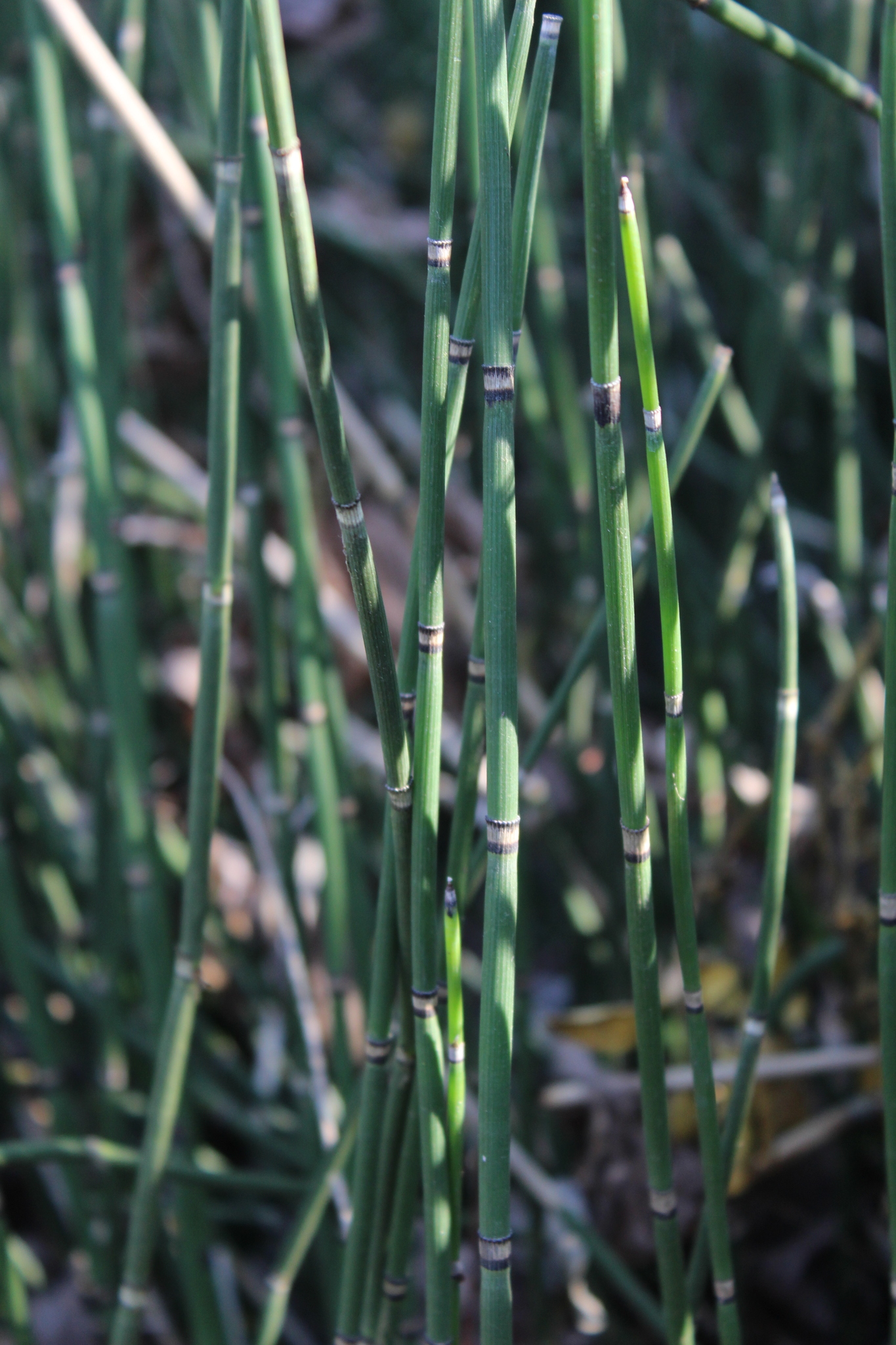
Rough Horsetail
Equisetum hyemale
Also listed as Equisetum alpinum, Hippochaete hyemalis
Also known as Scouring-rush, Tall Scouringrush, Common Scouring-rush
Climate Match for your location
See how well Rough Horsetail grows in your area.
Enter your ZIP code and we'll show you how this plant fits your local climate.
A primitive, non-flowering perennial with jointed, tubular green stems that resembles bamboo in appearance. It thrives in wet areas and spreads vigorously, making it useful for erosion control or naturalizing moist sites.
Why grow it
Rough horsetail outperforms many ornamental grasses in poorly drained or seasonally wet soils where conventional groundcovers struggle. Unlike most moisture-loving perennials, it tolerates both standing water and acidic conditions, making it a practical choice for rain gardens, stream banks, or low spots with slow drainage. Its upright, articulated stems provide textural contrast to broad-leaved plants in wet-site compositions.
Watch out for
This species spreads by creeping rhizomes and can be slow to establish in the first season, requiring patience before fill-in occurs. The silica-rich stems are stiff and may be uncomfortable to handle bare-handed during maintenance. In contained garden settings, regular thinning helps maintain density and prevent the planting from becoming sparse or lopsided over time.
Overview
- Form
- Growth Rate
- Size
- Dormancy
- Family
- Equisetaceae
Native to the United States
Native Range
Northern Hemisphere, including North America and Eurasia
Native to: Alaska, California, Colorado, Connecticut, Idaho, Illinois, Indiana, Iowa, Maine, Maryland, Massachusetts, Michigan, Minnesota, Missouri, Montana, Nebraska, New Hampshire, New Jersey, New York, North Carolina, North Dakota, Ohio, Oregon, Pennsylvania, Rhode Island, Vermont, Virginia, Washington, West Virginia, Wisconsin, Wyoming
Seasonality
Season of Interest
Herb
Soft non-woody plants of the field layer.
Succession Role
Tolerances & Soil
Establishment & Care
- Establishment
- Maintenance
- Propagation
A primitive, non-flowering perennial with jointed, tubular green stems that resembles bamboo in appearance. It thrives in wet areas and spreads vigorously, making it useful for erosion control or naturalizing moist sites.
Climate Match for your location
See how well Rough Horsetail grows in your area.
Enter your ZIP code and we'll show you how this plant fits your local climate.
Why grow it
Rough horsetail outperforms many ornamental grasses in poorly drained or seasonally wet soils where conventional groundcovers struggle. Unlike most moisture-loving perennials, it tolerates both standing water and acidic conditions, making it a practical choice for rain gardens, stream banks, or low spots with slow drainage. Its upright, articulated stems provide textural contrast to broad-leaved plants in wet-site compositions.
Watch out for
This species spreads by creeping rhizomes and can be slow to establish in the first season, requiring patience before fill-in occurs. The silica-rich stems are stiff and may be uncomfortable to handle bare-handed during maintenance. In contained garden settings, regular thinning helps maintain density and prevent the planting from becoming sparse or lopsided over time.
Overview
- Form
- Growth Rate
- Size
- Dormancy
- Family
- Equisetaceae
Native to the United States
Native Range
Northern Hemisphere, including North America and Eurasia
Native to: Alaska, California, Colorado, Connecticut, Idaho, Illinois, Indiana, Iowa, Maine, Maryland, Massachusetts, Michigan, Minnesota, Missouri, Montana, Nebraska, New Hampshire, New Jersey, New York, North Carolina, North Dakota, Ohio, Oregon, Pennsylvania, Rhode Island, Vermont, Virginia, Washington, West Virginia, Wisconsin, Wyoming
Seasonality
Season of Interest
Herb
Soft non-woody plants of the field layer.
Succession Role
Tolerances & Soil
Establishment & Care
- Establishment
- Maintenance
- Propagation
Similar herbs you might consider:
Enter your ZIP code to see top native species and strong climate fits for you.