Spotted Horsemint
Monarda punctata
Also known as Spotted Beebalm, Dotted Mint, Dotted Horsemint
Climate Match for your location
See how well Spotted Horsemint grows in your area.
Enter your ZIP code and we'll show you how this plant fits your local climate.
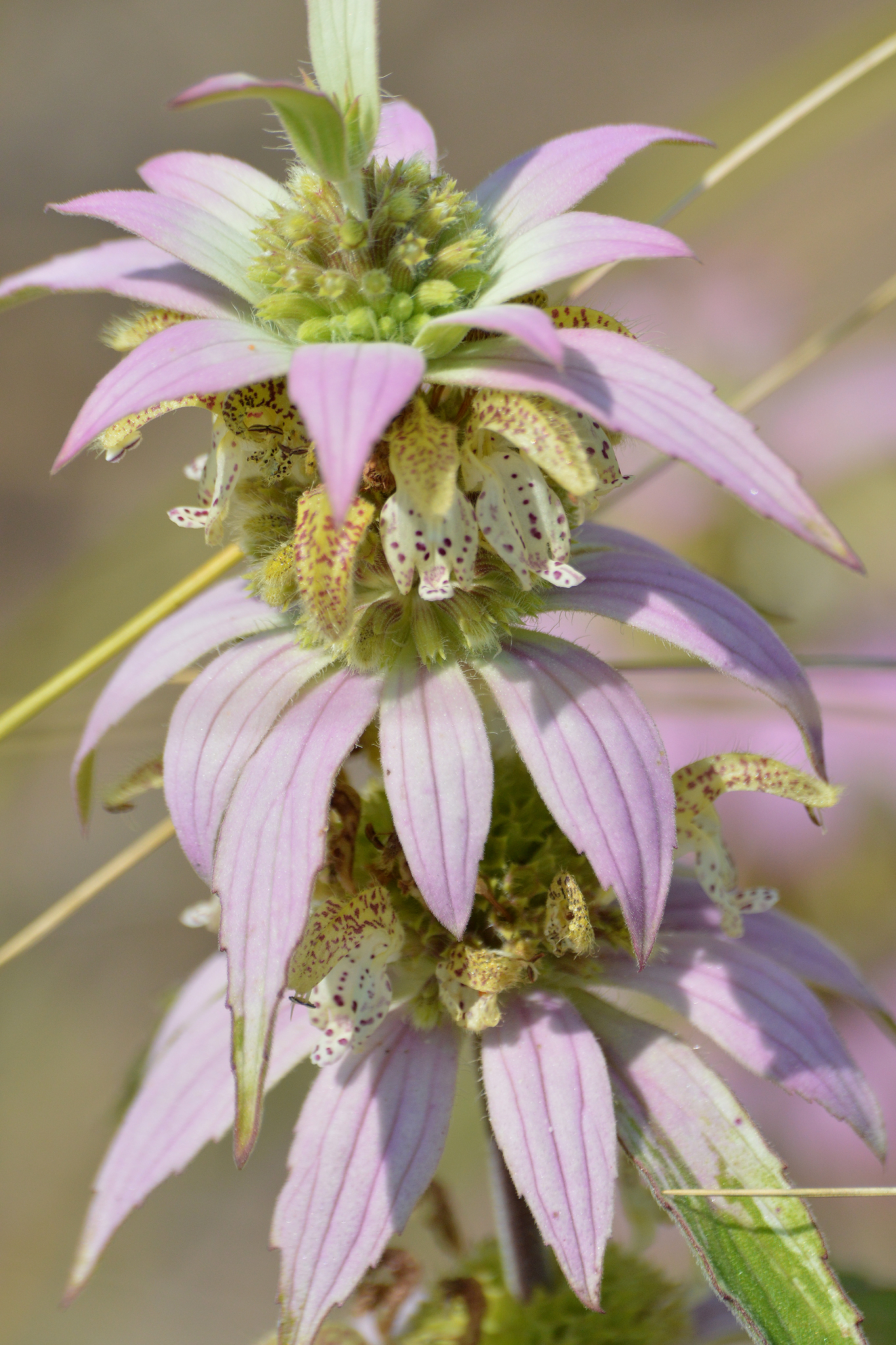
A showy native wildflower with distinctive tiered flower heads in shades of red, pink, purple, or white, attracting butterflies and hummingbirds. Extremely drought-tolerant and low-maintenance once established.
Why grow it
Spotted horsemint offers reliable mid-summer bloom and pollinator appeal in drier settings where many flowering perennials struggle. Compared to other Monarda species, it tolerates poor, sandy, or gravelly soils better than bee balm, and its compact habit (typically 1.5 to 2.5 feet) requires less division and management than taller cultivars. Its tiered flower structure provides a distinct visual interest among native wildflowers suitable for prairie or xeriscape gardens.
Watch out for
In consistently moist or humid conditions, this plant is prone to powdery mildew, even though it performs well in dry climates. Spacing plants adequately and ensuring good air circulation will minimize fungal pressure. Self-seeding can be generous in ideal conditions, so deadheading spent flowers may be necessary if you wish to control spread in smaller garden areas.
Overview
- Form
- Growth Rate
- Size
- Dormancy
- Family
- Lamiaceae
Native to the United States
Native Range
Central and southern United States
Native to: Alabama, Arkansas, Connecticut, District of Columbia, Florida, Georgia, Iowa, Illinois, Indiana, Kansas, Kentucky, Louisiana, Massachusetts, Maryland, Michigan, Minnesota, Missouri, Mississippi, North Carolina, New Jersey, New Mexico, New York, Ohio, Oklahoma, Pennsylvania, South Carolina, Tennessee, Texas, Virginia, Vermont, Wisconsin
Seasonality
Bloom Season
Harvest Season
Edible Parts
Season of Interest
Herb
Soft non-woody plants of the field layer.
Succession Role
Tolerances & Soil
Establishment & Care
- Establishment
- Maintenance
- Propagation
A showy native wildflower with distinctive tiered flower heads in shades of red, pink, purple, or white, attracting butterflies and hummingbirds. Extremely drought-tolerant and low-maintenance once established.
Climate Match for your location
See how well Spotted Horsemint grows in your area.
Enter your ZIP code and we'll show you how this plant fits your local climate.
Why grow it
Spotted horsemint offers reliable mid-summer bloom and pollinator appeal in drier settings where many flowering perennials struggle. Compared to other Monarda species, it tolerates poor, sandy, or gravelly soils better than bee balm, and its compact habit (typically 1.5 to 2.5 feet) requires less division and management than taller cultivars. Its tiered flower structure provides a distinct visual interest among native wildflowers suitable for prairie or xeriscape gardens.
Watch out for
In consistently moist or humid conditions, this plant is prone to powdery mildew, even though it performs well in dry climates. Spacing plants adequately and ensuring good air circulation will minimize fungal pressure. Self-seeding can be generous in ideal conditions, so deadheading spent flowers may be necessary if you wish to control spread in smaller garden areas.
Overview
- Form
- Growth Rate
- Size
- Dormancy
- Family
- Lamiaceae
Native to the United States
Native Range
Central and southern United States
Native to: Alabama, Arkansas, Connecticut, District of Columbia, Florida, Georgia, Iowa, Illinois, Indiana, Kansas, Kentucky, Louisiana, Massachusetts, Maryland, Michigan, Minnesota, Missouri, Mississippi, North Carolina, New Jersey, New Mexico, New York, Ohio, Oklahoma, Pennsylvania, South Carolina, Tennessee, Texas, Virginia, Vermont, Wisconsin
Seasonality
Bloom Season
Harvest Season
Edible Parts
Season of Interest
Herb
Soft non-woody plants of the field layer.
Succession Role
Tolerances & Soil
Establishment & Care
- Establishment
- Maintenance
- Propagation
Similar herbs you might consider:
Enter your ZIP code to see top native species and strong climate fits for you.