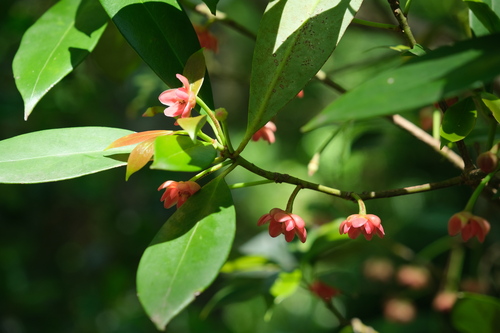
Star Anise
Illicium verum
Climate Match for your location
See how well Star Anise grows in your area.
Enter your ZIP code and we'll show you how this plant fits your local climate.
Star anise is a small evergreen tree native to southwest China, prized for its distinctive star-shaped fruits used as a spice and in traditional medicine. It produces fragrant yellow flowers in spring followed by the characteristic hard, multi-pointed seed pods valued in culinary and herbal applications.
Overview
- Form
- Growth Rate
- Size
- Dormancy
- Family
Native Range
Southwest China (Yunnan and Guangxi provinces)
Seasonality
Bloom Season
Harvest Season
Season of Interest
Notable Cultivars
Most commercially grown star anise is the species itself (Illicium verum); limited named cultivars exist, with cultivation focused on seed-bearing selection rather than ornamental variation.
Sub-canopy
Smaller trees living beneath the canopy.
Tolerances & Soil
Function & Care
Edible Parts
Establishment & Care
- Establishment
- Maintenance
- Years to Bearing
- Propagation
Star anise is a small evergreen tree native to southwest China, prized for its distinctive star-shaped fruits used as a spice and in traditional medicine. It produces fragrant yellow flowers in spring followed by the characteristic hard, multi-pointed seed pods valued in culinary and herbal applications.
Climate Match for your location
See how well Star Anise grows in your area.
Enter your ZIP code and we'll show you how this plant fits your local climate.
Overview
- Form
- Growth Rate
- Size
- Dormancy
- Family
Native Range
Southwest China (Yunnan and Guangxi provinces)
Seasonality
Bloom Season
Harvest Season
Season of Interest
Sub-canopy
Smaller trees living beneath the canopy.
Tolerances & Soil
Function & Care
Edible Parts
Establishment & Care
- Establishment
- Maintenance
- Years to Bearing
- Propagation
Companion Planting
Plants well with
Notable Cultivars
Most commercially grown star anise is the species itself (Illicium verum); limited named cultivars exist, with cultivation focused on seed-bearing selection rather than ornamental variation.