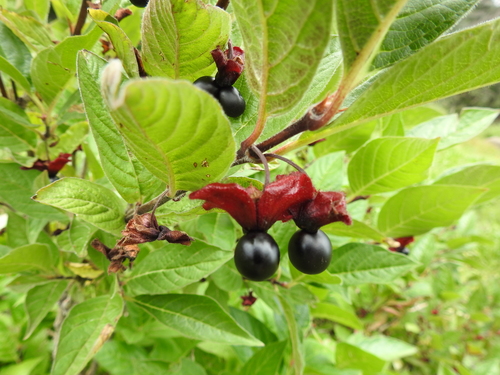
twinberry honeysuckle
Lonicera involucrata
Climate Match for your location
See how well twinberry honeysuckle grows in your area.
Enter your ZIP code and we'll show you how this plant fits your local climate.
A native Pacific Northwest shrub with twin yellowish-white flowers followed by glossy black berries loved by wildlife. It thrives in part shade with moderate moisture and makes an excellent addition to native plant gardens.
Overview
- Form
- Growth Rate
- Size
- Dormancy
- Family
Native to the United States
Native Range
Pacific Northwest and western North America
Native to: Washington, Oregon, California, Idaho, Montana, Wyoming, Colorado, New Mexico, Arizona, Utah, Nevada
Seasonality
Bloom Season
Harvest Season
Season of Interest
Notable Cultivars
Cultivars are not widely commercialized; wild-collected or native seed sources are typically used in ecological restoration projects.
Shrub
Woody multi-stem plants at eye level.
Succession Role
Tolerances & Soil
Flood Tolerance
pH Range
Soil Texture
Function & Care
Edible Parts
Establishment & Care
- Establishment
- Maintenance
- Years to Bearing
- Propagation
A native Pacific Northwest shrub with twin yellowish-white flowers followed by glossy black berries loved by wildlife. It thrives in part shade with moderate moisture and makes an excellent addition to native plant gardens.
Climate Match for your location
See how well twinberry honeysuckle grows in your area.
Enter your ZIP code and we'll show you how this plant fits your local climate.
Overview
- Form
- Growth Rate
- Size
- Dormancy
- Family
Native to the United States
Native Range
Pacific Northwest and western North America
Native to: Washington, Oregon, California, Idaho, Montana, Wyoming, Colorado, New Mexico, Arizona, Utah, Nevada
Seasonality
Bloom Season
Harvest Season
Season of Interest
Shrub
Woody multi-stem plants at eye level.
Succession Role
Tolerances & Soil
Flood Tolerance
pH Range
Soil Texture
Function & Care
Edible Parts
Establishment & Care
- Establishment
- Maintenance
- Years to Bearing
- Propagation
Companion Planting
Plants well with
Notable Cultivars
Cultivars are not widely commercialized; wild-collected or native seed sources are typically used in ecological restoration projects.