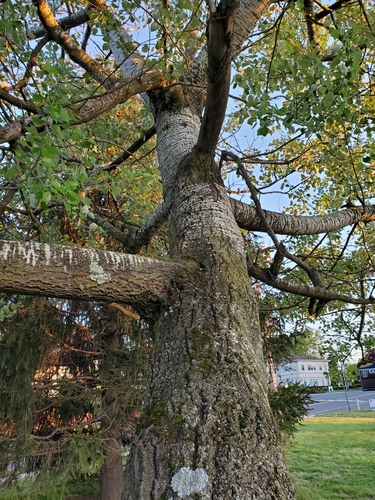
White Poplar
Populus alba
Also listed as Leuce alba, Populus acerifolia
Also known as European White Poplar, Silver Poplar, Abele
Climate Match for your location
See how well White Poplar grows in your area.
Enter your ZIP code and we'll show you how this plant fits your local climate.
A fast-growing deciduous tree with distinctive white-backed leaves that shimmer in the breeze and striking white bark. Tolerant of poor soil and urban conditions, though it can be invasive in some regions.
Why grow it
White poplar grows rapidly in poor soils and urban settings where many ornamental trees struggle, making it useful for quick screening or windbreaks on marginal land. Compared to native poplars, its distinctive white-backed foliage and pale bark provide notable visual contrast, though similar fast growth and soil tolerance can be found in other Populus species adapted to your region. Consider native alternatives where available, as they typically integrate better with local wildlife and soil ecology.
Watch out for
The vigorous root system can damage nearby pavement, drainage systems, and structures if planted too close to buildings or infrastructure. Extensive suckering from roots may create volunteer shoots across a property, requiring ongoing management to prevent the tree from spreading beyond its intended location.
Overview
- Form
- Growth Rate
- Size
- Dormancy
- Family
- Salicaceae
Native Range
Europe and western Asia
Seasonality
Season of Interest
Canopy
The tallest trees that form the overstory.
Succession Role
Tolerances & Soil
Flood Tolerance
Deer Resistance
Inferred from USDA browse palatability
pH Range
Soil Texture
Establishment & Care
- Establishment
- Maintenance
- Propagation
A fast-growing deciduous tree with distinctive white-backed leaves that shimmer in the breeze and striking white bark. Tolerant of poor soil and urban conditions, though it can be invasive in some regions.
Climate Match for your location
See how well White Poplar grows in your area.
Enter your ZIP code and we'll show you how this plant fits your local climate.
Why grow it
White poplar grows rapidly in poor soils and urban settings where many ornamental trees struggle, making it useful for quick screening or windbreaks on marginal land. Compared to native poplars, its distinctive white-backed foliage and pale bark provide notable visual contrast, though similar fast growth and soil tolerance can be found in other Populus species adapted to your region. Consider native alternatives where available, as they typically integrate better with local wildlife and soil ecology.
Watch out for
The vigorous root system can damage nearby pavement, drainage systems, and structures if planted too close to buildings or infrastructure. Extensive suckering from roots may create volunteer shoots across a property, requiring ongoing management to prevent the tree from spreading beyond its intended location.
Overview
- Form
- Growth Rate
- Size
- Dormancy
- Family
- Salicaceae
Native Range
Europe and western Asia
Seasonality
Season of Interest
Canopy
The tallest trees that form the overstory.
Succession Role
Tolerances & Soil
Flood Tolerance
Deer Resistance
Inferred from USDA browse palatability
pH Range
Soil Texture
Establishment & Care
- Establishment
- Maintenance
- Propagation
Similar canopy trees you might consider:
Enter your ZIP code to see top native species and strong climate fits for you.