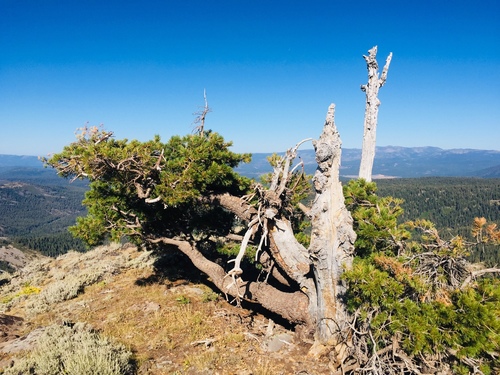
Whitebark pine
Pinus albicaulis
Climate Match for your location
See how well Whitebark pine grows in your area.
Enter your ZIP code and we'll show you how this plant fits your local climate.
A high-altitude pine with distinctive whitish bark and dense, compact foliage that turns reddish in winter cold. This slow-growing conifer is increasingly important for alpine and subalpine landscapes as lower-elevation pines decline.
Overview
- Form
- Growth Rate
- Size
- Dormancy
- Family
Native to the United States
Native Range
Western North America (Rocky Mountains and Cascade Range)
Native to: California, Colorado, Idaho, Montana, Nevada, Oregon, Utah, Washington, Wyoming
Seasonality
Bloom Season
Season of Interest
Canopy
The tallest trees that form the overstory.
Sub-canopy
Smaller trees living beneath the canopy.
Succession Role
Tolerances & Soil
Flood Tolerance
pH Range
Soil Texture
Function & Care
Establishment & Care
- Establishment
- Maintenance
- Propagation
A high-altitude pine with distinctive whitish bark and dense, compact foliage that turns reddish in winter cold. This slow-growing conifer is increasingly important for alpine and subalpine landscapes as lower-elevation pines decline.
Climate Match for your location
See how well Whitebark pine grows in your area.
Enter your ZIP code and we'll show you how this plant fits your local climate.
Overview
- Form
- Growth Rate
- Size
- Dormancy
- Family
Native to the United States
Native Range
Western North America (Rocky Mountains and Cascade Range)
Native to: California, Colorado, Idaho, Montana, Nevada, Oregon, Utah, Washington, Wyoming
Seasonality
Bloom Season
Season of Interest
Canopy
The tallest trees that form the overstory.
Sub-canopy
Smaller trees living beneath the canopy.
Succession Role
Tolerances & Soil
Flood Tolerance
pH Range
Soil Texture
Function & Care
Establishment & Care
- Establishment
- Maintenance
- Propagation