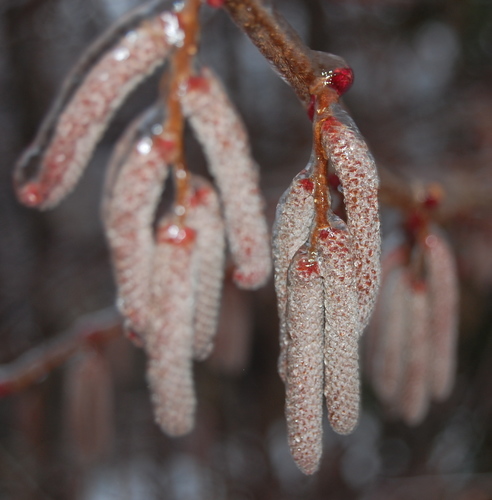
Allegheny Blackberry
Rubus allegheniensis
Also listed as Rubus auroralis, Rubus sativus
Also known as American Blackberry, Highbush Blackberry, Sow-teat Blackberry
Climate Match for your location
See how well Allegheny Blackberry grows in your area.
Enter your ZIP code and we'll show you how this plant fits your local climate.
A thorny native bramble producing sweet black berries in mid-summer. Vigorous and spreading, it thrives in open areas and is valuable for wildlife.
Why grow it
Allegheny blackberry is a cold-hardy native bramble that tolerates poorer soils and drier conditions better than many cultivated blackberry varieties. It produces smaller but distinctly sweet fruit mid-summer and establishes quickly in disturbed ground or field edges, making it suitable for wildlife corridors and erosion control on marginal land. Compared to hybrid thornless cultivars, it requires minimal inputs but offers less fruit volume per plant.
Watch out for
Canes can become densely tangled and difficult to manage without regular pruning, especially in ideal growing conditions. Expect vigorous lateral spread via rhizomes, which may require periodic containment in smaller gardens. New plantings typically take two seasons to reach full productive capacity.
Overview
- Form
- Growth Rate
- Size
- Dormancy
- Family
- Rosaceae
Native to the United States
Native Range
Eastern North America
Native to: Alabama, Arkansas, Connecticut, District of Columbia, Delaware, Georgia, Iowa, Illinois, Indiana, Kansas, Kentucky, Massachusetts, Maryland, Maine, Michigan, Minnesota, Missouri, North Carolina, Nebraska, New Hampshire, New Jersey, New York, Ohio, Oklahoma, Pennsylvania, Rhode Island, South Carolina, Tennessee, Virginia, Vermont, Wisconsin, West Virginia
Seasonality
Bloom Season
Harvest Season
Edible Parts
Season of Interest
Shrub
Woody multi-stem plants at eye level.
Succession Role
Tolerances & Soil
Flood Tolerance
Deer Resistance
Inferred from USDA browse palatability
pH Range
Soil Texture
Establishment & Care
- Establishment
- Maintenance
- Years to Bearing
- Propagation
A thorny native bramble producing sweet black berries in mid-summer. Vigorous and spreading, it thrives in open areas and is valuable for wildlife.
Climate Match for your location
See how well Allegheny Blackberry grows in your area.
Enter your ZIP code and we'll show you how this plant fits your local climate.
Why grow it
Allegheny blackberry is a cold-hardy native bramble that tolerates poorer soils and drier conditions better than many cultivated blackberry varieties. It produces smaller but distinctly sweet fruit mid-summer and establishes quickly in disturbed ground or field edges, making it suitable for wildlife corridors and erosion control on marginal land. Compared to hybrid thornless cultivars, it requires minimal inputs but offers less fruit volume per plant.
Watch out for
Canes can become densely tangled and difficult to manage without regular pruning, especially in ideal growing conditions. Expect vigorous lateral spread via rhizomes, which may require periodic containment in smaller gardens. New plantings typically take two seasons to reach full productive capacity.
Overview
- Form
- Growth Rate
- Size
- Dormancy
- Family
- Rosaceae
Native to the United States
Native Range
Eastern North America
Native to: Alabama, Arkansas, Connecticut, District of Columbia, Delaware, Georgia, Iowa, Illinois, Indiana, Kansas, Kentucky, Massachusetts, Maryland, Maine, Michigan, Minnesota, Missouri, North Carolina, Nebraska, New Hampshire, New Jersey, New York, Ohio, Oklahoma, Pennsylvania, Rhode Island, South Carolina, Tennessee, Virginia, Vermont, Wisconsin, West Virginia
Seasonality
Bloom Season
Harvest Season
Edible Parts
Season of Interest
Shrub
Woody multi-stem plants at eye level.
Succession Role
Tolerances & Soil
Flood Tolerance
Deer Resistance
Inferred from USDA browse palatability
pH Range
Soil Texture
Establishment & Care
- Establishment
- Maintenance
- Years to Bearing
- Propagation
Similar shrubs you might consider:
Enter your ZIP code to see top native species and strong climate fits for you.