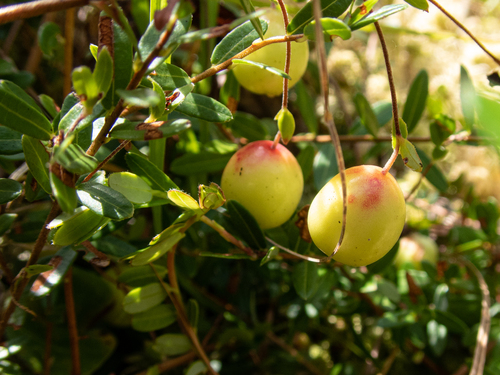
Lowbush Blueberry
Vaccinium angustifolium
Also listed as Vaccinium brittonii, Vaccinium lamarckii
Also known as Blueberry, Northern Lowbush Blueberry, Early Lowbush Blueberry
Climate Match for your location
See how well Lowbush Blueberry grows in your area.
Enter your ZIP code and we'll show you how this plant fits your local climate.
A low-growing native shrub that produces small white or pink bell-shaped flowers in spring followed by abundant edible blue berries in summer. Foliage turns beautiful shades of red and orange in fall.
Why grow it
Lowbush blueberry is notably more cold-hardy and drought-tolerant than its highbush relatives, making it suitable for northern climates and sandy or acidic soils where other berry crops struggle. It requires less pruning and maintenance than cultivated highbush varieties while still producing reliable yields, though berries are smaller and harvest is more labor-intensive. This species is particularly valuable in permaculture systems for its role as a wildlife food source and its ability to establish on marginal land.
Watch out for
Plants respond poorly to alkaline soils and will show chlorosis in neutral or slightly basic conditions; soil acidification may be necessary in some regions. Productivity depends heavily on adequate moisture during fruiting, especially in sandy soils prone to drying. Fruit ripens unevenly over several weeks, so multiple harvests are needed to collect a substantial crop.
Overview
- Form
- Growth Rate
- Size
- Dormancy
- Family
- Ericaceae
Native to the United States
Native Range
Eastern North America
Native to: Connecticut, Delaware, Iowa, Illinois, Indiana, Massachusetts, Maryland, Maine, Michigan, Minnesota, North Carolina, New Hampshire, New Jersey, New York, Ohio, Pennsylvania, Rhode Island, Tennessee, Virginia, Vermont, Wisconsin, West Virginia
Seasonality
Bloom Season
Harvest Season
Edible Parts
Season of Interest
Shrub
Woody multi-stem plants at eye level.
Succession Role
Tolerances & Soil
Flood Tolerance
Deer Resistance
Inferred from USDA browse palatability
pH Range
Soil Texture
Establishment & Care
- Establishment
- Maintenance
- Years to Bearing
- Propagation
A low-growing native shrub that produces small white or pink bell-shaped flowers in spring followed by abundant edible blue berries in summer. Foliage turns beautiful shades of red and orange in fall.
Climate Match for your location
See how well Lowbush Blueberry grows in your area.
Enter your ZIP code and we'll show you how this plant fits your local climate.
Why grow it
Lowbush blueberry is notably more cold-hardy and drought-tolerant than its highbush relatives, making it suitable for northern climates and sandy or acidic soils where other berry crops struggle. It requires less pruning and maintenance than cultivated highbush varieties while still producing reliable yields, though berries are smaller and harvest is more labor-intensive. This species is particularly valuable in permaculture systems for its role as a wildlife food source and its ability to establish on marginal land.
Watch out for
Plants respond poorly to alkaline soils and will show chlorosis in neutral or slightly basic conditions; soil acidification may be necessary in some regions. Productivity depends heavily on adequate moisture during fruiting, especially in sandy soils prone to drying. Fruit ripens unevenly over several weeks, so multiple harvests are needed to collect a substantial crop.
Overview
- Form
- Growth Rate
- Size
- Dormancy
- Family
- Ericaceae
Native to the United States
Native Range
Eastern North America
Native to: Connecticut, Delaware, Iowa, Illinois, Indiana, Massachusetts, Maryland, Maine, Michigan, Minnesota, North Carolina, New Hampshire, New Jersey, New York, Ohio, Pennsylvania, Rhode Island, Tennessee, Virginia, Vermont, Wisconsin, West Virginia
Seasonality
Bloom Season
Harvest Season
Edible Parts
Season of Interest
Shrub
Woody multi-stem plants at eye level.
Succession Role
Tolerances & Soil
Flood Tolerance
Deer Resistance
Inferred from USDA browse palatability
pH Range
Soil Texture
Establishment & Care
- Establishment
- Maintenance
- Years to Bearing
- Propagation
Similar shrubs you might consider:
Enter your ZIP code to see top native species and strong climate fits for you.