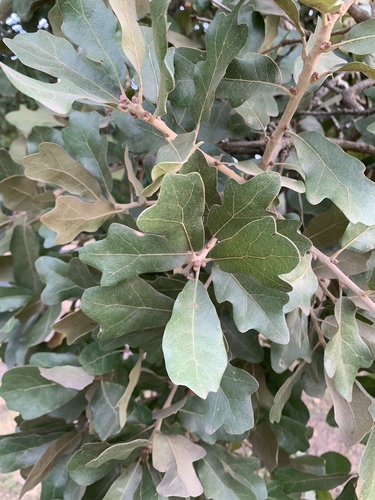
post oak
Quercus stellata
Climate Match for your location
See how well post oak grows in your area.
Enter your ZIP code and we'll show you how this plant fits your local climate.
Post oak is a native deciduous tree with a broad, rounded crown and distinctive cross-shaped leaves that turn russet-brown in fall. It is extremely drought-tolerant once established and prefers full sun, making it well-suited for dry, difficult sites.
Overview
- Form
- Growth Rate
- Size
- Dormancy
- Family
Native to the United States
Native Range
Southeastern United States
Native to: Alabama, Arkansas, Florida, Georgia, Kentucky, Louisiana, Mississippi, Missouri, North Carolina, Oklahoma, South Carolina, Tennessee, Texas, Virginia
Seasonality
Bloom Season
Season of Interest
Canopy
The tallest trees that form the overstory.
Sub-canopy
Smaller trees living beneath the canopy.
Succession Role
Tolerances & Soil
Flood Tolerance
pH Range
Soil Texture
Function & Care
Establishment & Care
- Establishment
- Maintenance
- Propagation
Post oak is a native deciduous tree with a broad, rounded crown and distinctive cross-shaped leaves that turn russet-brown in fall. It is extremely drought-tolerant once established and prefers full sun, making it well-suited for dry, difficult sites.
Climate Match for your location
See how well post oak grows in your area.
Enter your ZIP code and we'll show you how this plant fits your local climate.
Overview
- Form
- Growth Rate
- Size
- Dormancy
- Family
Native to the United States
Native Range
Southeastern United States
Native to: Alabama, Arkansas, Florida, Georgia, Kentucky, Louisiana, Mississippi, Missouri, North Carolina, Oklahoma, South Carolina, Tennessee, Texas, Virginia
Seasonality
Bloom Season
Season of Interest
Canopy
The tallest trees that form the overstory.
Sub-canopy
Smaller trees living beneath the canopy.
Succession Role
Tolerances & Soil
Flood Tolerance
pH Range
Soil Texture
Function & Care
Establishment & Care
- Establishment
- Maintenance
- Propagation