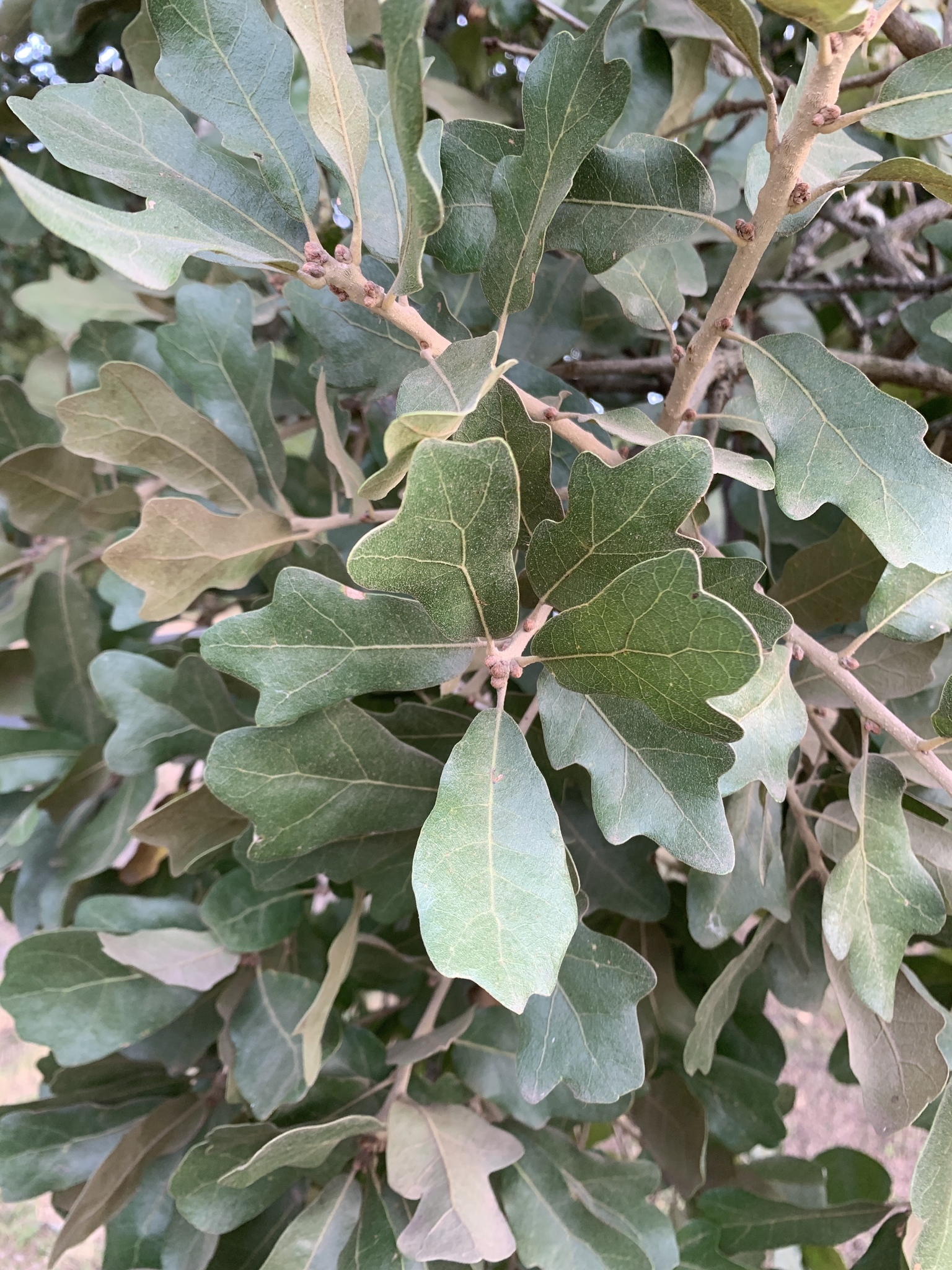
Post Oak
Quercus stellata
Also listed as Quercus floridana, Quercus fusca
Climate Match for your location
See how well Post Oak grows in your area.
Enter your ZIP code and we'll show you how this plant fits your local climate.
Post oak is a native deciduous tree with a broad, rounded crown and distinctive cross-shaped leaves that turn russet-brown in fall. It is extremely drought-tolerant once established and prefers full sun, making it well-suited for dry, difficult sites.
Why grow it
Post oak is notably more drought-tolerant than many other eastern oak species once established, making it a practical choice for sites with poor water retention or extended dry periods. Its moderate growth rate and moderate size make it more manageable than larger oak species for many landscapes. Compared to pin oak or water oak, post oak performs better in alkaline soils and sandy or gravelly sites typical of difficult locations.
Watch out for
Post oak can be slow to establish, sometimes requiring two to three years before showing vigorous growth, so regular watering during the first growing season improves survival rates. The tree's dense wood and branch structure can make pruning somewhat labor-intensive if structural training is desired early on.
Overview
- Form
- Growth Rate
- Size
- Dormancy
- Family
- Fagaceae
Native to the United States
Native Range
Southeastern United States
Native to: Alabama, Arkansas, Connecticut, Delaware, Florida, Georgia, Iowa, Illinois, Indiana, Kansas, Kentucky, Louisiana, Massachusetts, Maryland, Missouri, Mississippi, North Carolina, New Jersey, New York, Ohio, Oklahoma, Pennsylvania, Rhode Island, South Carolina, Tennessee, Texas, Virginia, West Virginia
Seasonality
Season of Interest
Canopy
The tallest trees that form the overstory.
Sub-canopy
Smaller trees living beneath the canopy.
Succession Role
Tolerances & Soil
Flood Tolerance
Deer Resistance
Inferred from USDA browse palatability
pH Range
Soil Texture
Establishment & Care
- Establishment
- Maintenance
- Propagation
Post oak is a native deciduous tree with a broad, rounded crown and distinctive cross-shaped leaves that turn russet-brown in fall. It is extremely drought-tolerant once established and prefers full sun, making it well-suited for dry, difficult sites.
Climate Match for your location
See how well Post Oak grows in your area.
Enter your ZIP code and we'll show you how this plant fits your local climate.
Why grow it
Post oak is notably more drought-tolerant than many other eastern oak species once established, making it a practical choice for sites with poor water retention or extended dry periods. Its moderate growth rate and moderate size make it more manageable than larger oak species for many landscapes. Compared to pin oak or water oak, post oak performs better in alkaline soils and sandy or gravelly sites typical of difficult locations.
Watch out for
Post oak can be slow to establish, sometimes requiring two to three years before showing vigorous growth, so regular watering during the first growing season improves survival rates. The tree's dense wood and branch structure can make pruning somewhat labor-intensive if structural training is desired early on.
Overview
- Form
- Growth Rate
- Size
- Dormancy
- Family
- Fagaceae
Native to the United States
Native Range
Southeastern United States
Native to: Alabama, Arkansas, Connecticut, Delaware, Florida, Georgia, Iowa, Illinois, Indiana, Kansas, Kentucky, Louisiana, Massachusetts, Maryland, Missouri, Mississippi, North Carolina, New Jersey, New York, Ohio, Oklahoma, Pennsylvania, Rhode Island, South Carolina, Tennessee, Texas, Virginia, West Virginia
Seasonality
Season of Interest
Canopy
The tallest trees that form the overstory.
Sub-canopy
Smaller trees living beneath the canopy.
Succession Role
Tolerances & Soil
Flood Tolerance
Deer Resistance
Inferred from USDA browse palatability
pH Range
Soil Texture
Establishment & Care
- Establishment
- Maintenance
- Propagation
Similar canopy trees you might consider:
Enter your ZIP code to see top native species and strong climate fits for you.